Overview
From submarine capture to XR guidance — the full perception and mapping chain in one view.
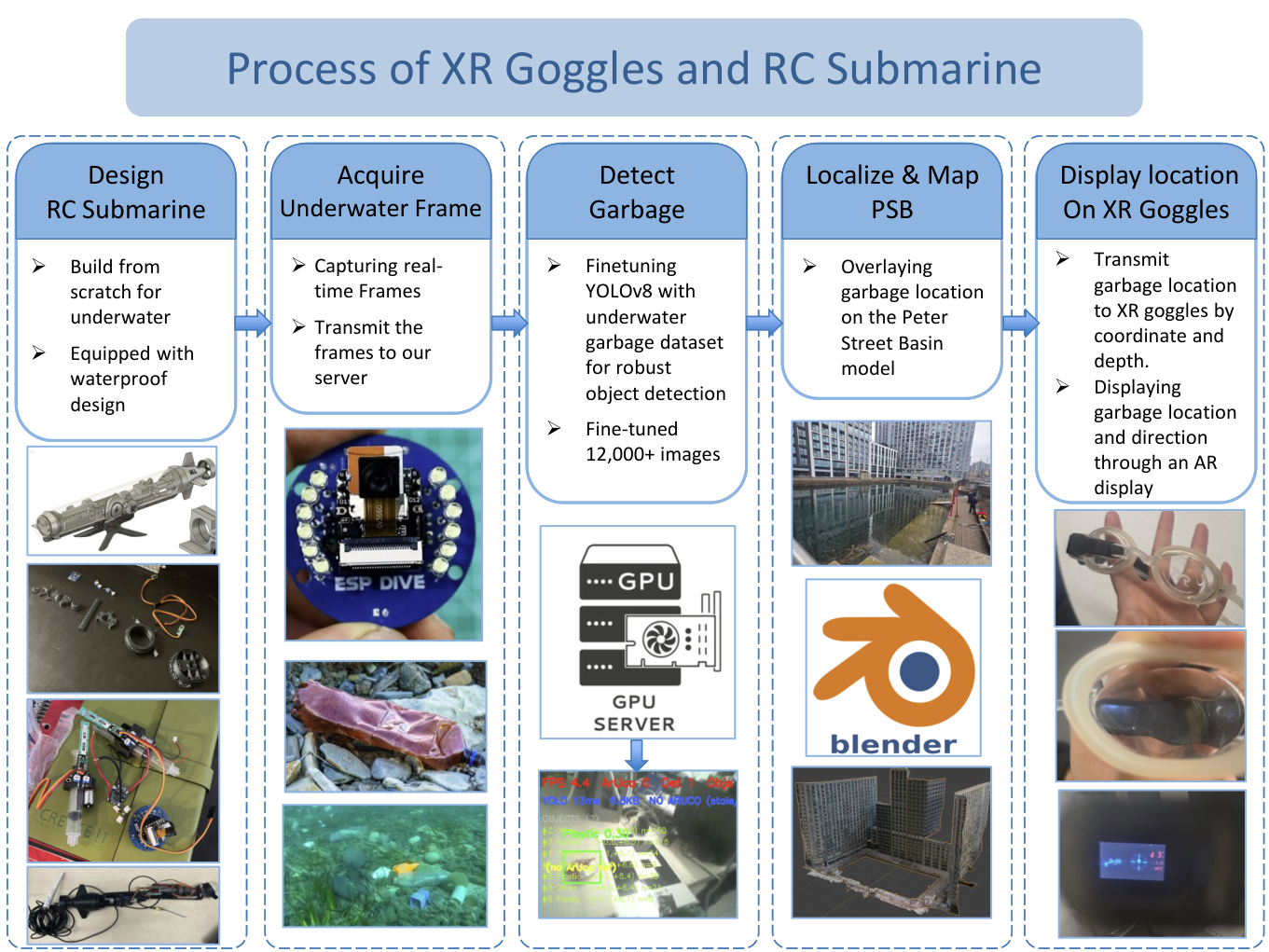
End-to-end pipeline
Key numbers
- Site
- Peter Street Basin, Toronto (~60 m × 30 m)
- Platform
- ESP-DIVE RC submarine, XIAO ESP32-S3 Sense
- Detector
- YOLOv8s, single class, 12,177 images
- Precision
- 92.1% on the combined validation set
- Mapping
- COLMAP SfM + ArUco, 796 / 823 frames registered
- Display
- Vuzix Smart Swim XR goggles (Android)
What this is, in plain terms
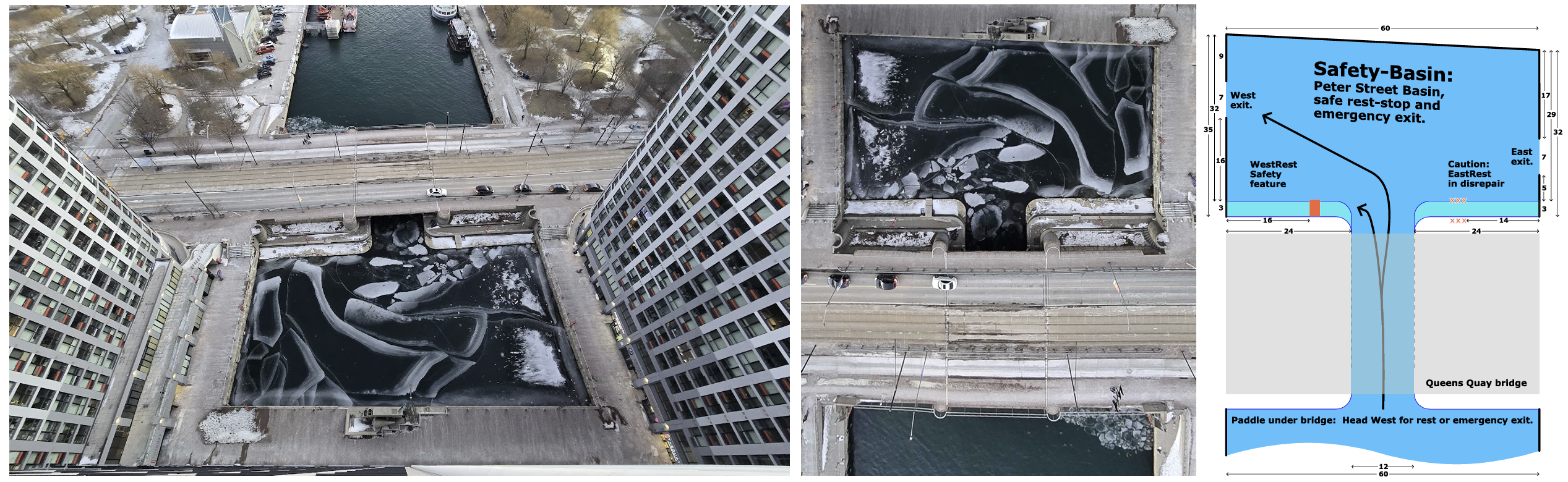
Peter Street Basin is an outdoor pool of Lake Ontario water in downtown Toronto, about 60 m by 30 m, connected to the inner harbour by a narrow channel under Queens Quay. It collects litter, and the litter sinks where nobody can see it.
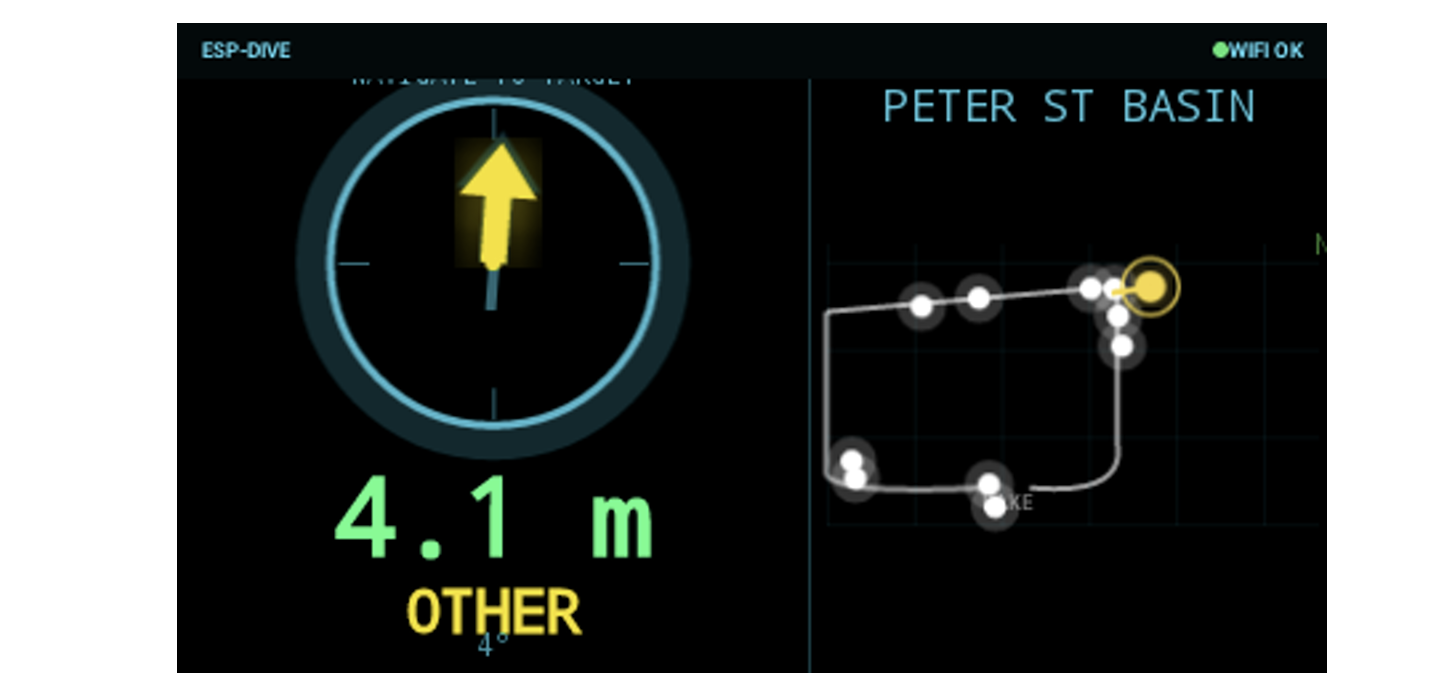
This project is the full chain from “nobody knows what is down there” to “swim 4 metres that way and pick it up.” We built a small submarine that carries a camera underwater, trained a detector to recognise garbage in murky water, reconstructed the basin in 3D so every detection has real coordinates, and pushed the nearest target onto a head-up display inside swim goggles.
The result is a human-in-the-loop system: the machine handles perception and geometry, the person handles the hands-in-the-water part.
The five stages
Each stage has its own page with decisions, specs, code locations, and what still needs work.
Results at a glance
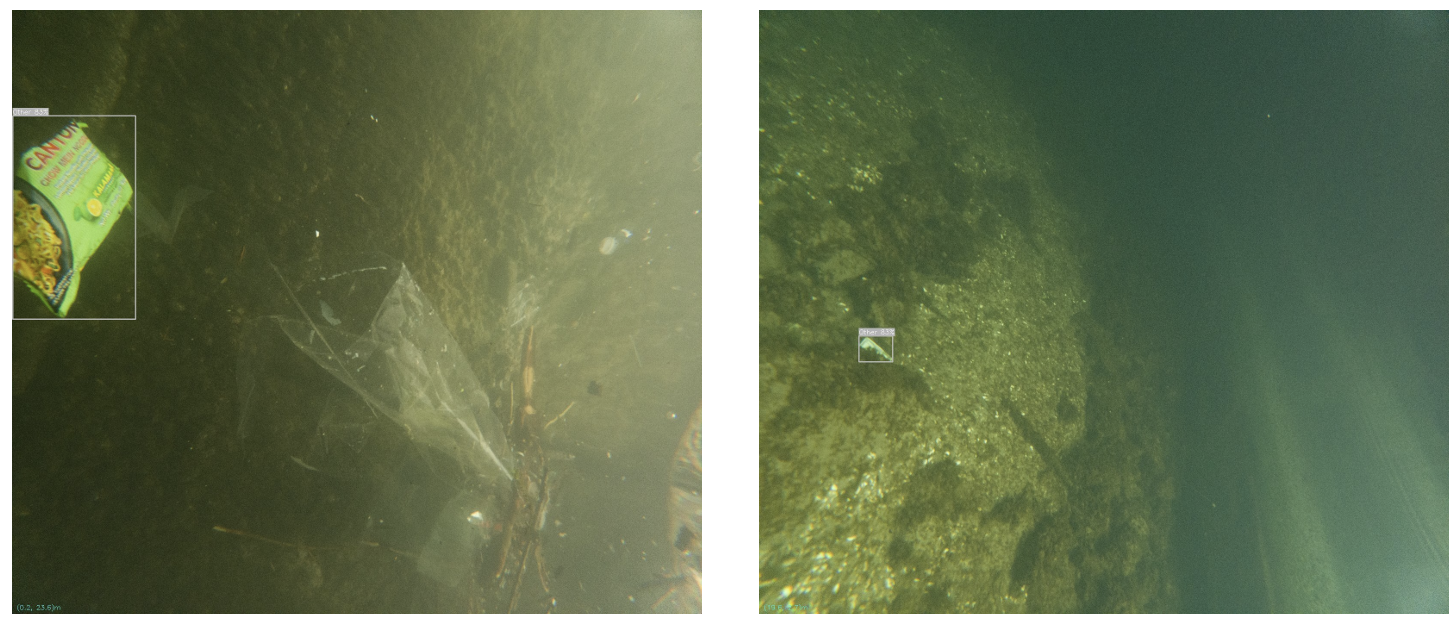
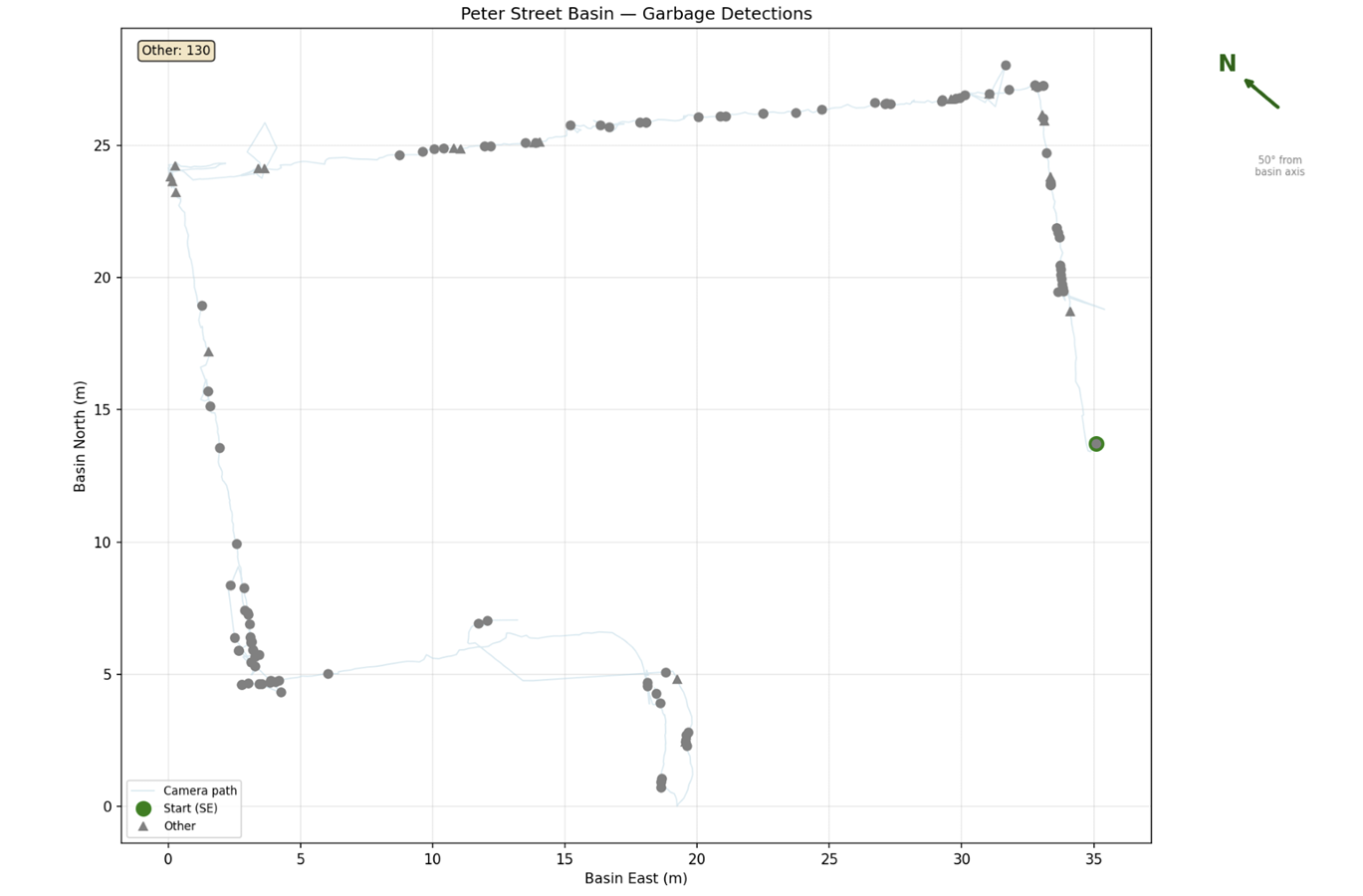
Field deployment figures from Peter Street Basin — detections, basin map, and the XR head-up display in operation.
Paper and credits
XR-Guided Garbage Detection with an RC Submarine for Peter Street Basin Cleanup
Chris McGale, Michel A. Herrera Viyella, Chan Park, Daniel Bros, Alexander Vicol, Steve Mann (corresponding author)
- Department of Electrical and Computer Engineering (ECE), University of Toronto
- Department of Mechanical and Industrial Engineering (MIE), University of Toronto
Presented at the Mersivity / WaterHCI Symposium 2026. Carried out with the Friends of Peter Street Basin.