

Interpretable Autonomous Driving VLA through Belief Distillation (IBD)
TL;DR
- A language-conditioned driving VLA writes a commentary and drives conditioned on it, so the commentary is both the explanation people read and an input to control.
- Its training labels come from privileged simulator state and can name causes the camera cannot see: safety knowledge, but unverifiable as a sentence.
- IBD rewrites the unseen cause into an honest caution phrase and distills the privileged teacher's caution into a camera-only belief token with a readable risk map.
- 언어 기반 주행 VLA는 해설을 먼저 쓰고 그 해설을 조건으로 주행합니다. 해설은 사람이 읽는 설명이면서 제어 입력입니다.
- 학습 라벨은 특권 시뮬레이터 상태로 만들어져 카메라가 볼 수 없는 원인을 말할 수 있습니다. 안전 지식이지만, 문장으로는 검증할 수 없는 주장입니다.
- IBD는 보이지 않는 원인을 정직한 주의 문구로 바꾸고, 특권 교사의 감속을 위험 지도로 읽을 수 있는 카메라 기반 신념 토큰으로 증류합니다.
- 语言条件驾驶 VLA 先写解说、再以解说为条件驾驶,因此解说既是人阅读的解释,也是控制输入。
- 其训练标签来自仿真器特权状态,可能提到相机看不到的原因:这是安全知识,但写成句子就无法验证。
- IBD 把看不见的原因改写为如实的提醒用语,并把特权教师的减速蒸馏到仅用相机、带可读风险地图的信念 token 中。
Motivation연구 동기研究动机
- Accidents demand a reason. After an accident, people need to read why the car decided as it did: to find the cause, assign responsibility, and prevent the next one.
- Language makes the reason readable. A language-conditioned driving VLA such as SimLingo writes a commentary, e.g. “Decelerate due to the child.”, and then drives conditioned on it.
- So the explanation must be true. The same sentence is the reason a person reads and an input the controller uses.
- Privileged labels carry safety knowledge. The training commentary is written by a rule-based generator from the full simulator state. It can name a child the camera cannot see yet, and the expert planner that shares this state already slows down. That is exactly the knowledge that prevents accidents, but as a sentence it is a claim the camera cannot verify.
- 사고에는 이유가 필요합니다. 사고가 나면 사람이 “왜 그렇게 판단했는가”를 읽을 수 있어야 원인을 찾고, 책임을 가리고, 같은 사고를 막을 수 있습니다.
- 언어는 그 이유를 읽을 수 있게 만듭니다. SimLingo 같은 언어 기반 주행 VLA는 “Decelerate due to the child.” 같은 해설을 먼저 쓰고, 그 해설을 조건으로 주행합니다.
- 그래서 설명은 사실이어야 합니다. 같은 문장이 사람이 읽는 이유이자 제어기가 쓰는 입력이기 때문입니다.
- 특권 라벨에는 안전 지식이 담겨 있습니다. 학습용 해설은 시뮬레이터 전체 상태를 아는 규칙 기반 생성기가 씁니다. 그래서 카메라에 보이지 않는 아이를 말할 수 있고, 같은 정보로 계획하는 전문가는 이미 감속합니다. 사고를 막는 데 필요한 바로 그 지식이지만, 문장으로 가르치면 카메라가 검증할 수 없는 주장이 됩니다.
- 事故需要原因。发生事故后,人们需要读懂车辆为何这样决策,才能找到原因、明确责任并防止再次发生。
- 语言让原因变得可读。SimLingo 等语言条件驾驶 VLA 会先写出解说,例如“Decelerate due to the child.”,再以该解说为条件驾驶。
- 因此解说必须属实。同一句话既是人阅读的理由,也是控制器使用的输入。
- 特权标签蕴含安全知识。训练用解说由掌握完整仿真状态的规则生成器写成,因此可以提到相机尚未看到的儿童,而共享这些信息的专家规划器已经开始减速。这正是防止事故所需的知识,但写成句子时,它就成了相机无法验证的陈述。
Problem문제问题
- Language steers the car. Giving the same camera image a different commentary changes the predicted path and speed. The commentary is a control input, not narration.
- Deleting the hallucinated sentence deletes the command. The braking command lives in the verb (“Decelerate …”). Removing an unsupported sentence also removes the command, so a fix has to keep the verb and change only the cause.
- Dropping privileged labels is not the answer. Labels at scale come from the simulator, and they are where the safety signal comes from. IBD converts this information instead of deleting it: it serves as a teacher during training, while the commentary stays honest.
- 언어가 차를 움직입니다. 같은 카메라 이미지에 다른 해설을 넣으면 예측 경로와 속도가 바뀝니다. 해설은 설명이 아니라 제어 입력입니다.
- 환각 문장을 지우면 명령도 지워집니다. 감속 명령은 동사(“Decelerate …”)에 실려 있습니다. 근거 없는 문장을 통째로 지우면 명령도 함께 사라지므로, 동사는 남기고 원인만 바꿔야 합니다.
- 특권 라벨을 버리는 것이 답은 아닙니다. 대규모 라벨은 시뮬레이터에서 나오고, 안전 신호도 거기서 나옵니다. IBD는 이 정보를 지우지 않고 바꿉니다. 학습 때는 교사 신호로 쓰고, 해설은 정직하게 유지합니다.
- 语言在操控车辆。给同一张相机图像换一句解说,预测的路径和速度就会改变。解说是控制输入,而不是叙述。
- 删除幻觉句子也会删除指令。制动指令在动词里(“Decelerate …”)。整句删除无依据的句子会连同指令一起删除,所以修复时要保留动词、只改原因。
- 丢弃特权标签不是答案。大规模标签来自仿真器,安全信号也来自那里。IBD 不删除这些信息,而是转换它:训练时把它作为教师信号,解说则保持如实。
Method: Interpretable Belief Distillation (IBD)방법: Interpretable Belief Distillation (IBD)方法:Interpretable Belief Distillation(IBD)
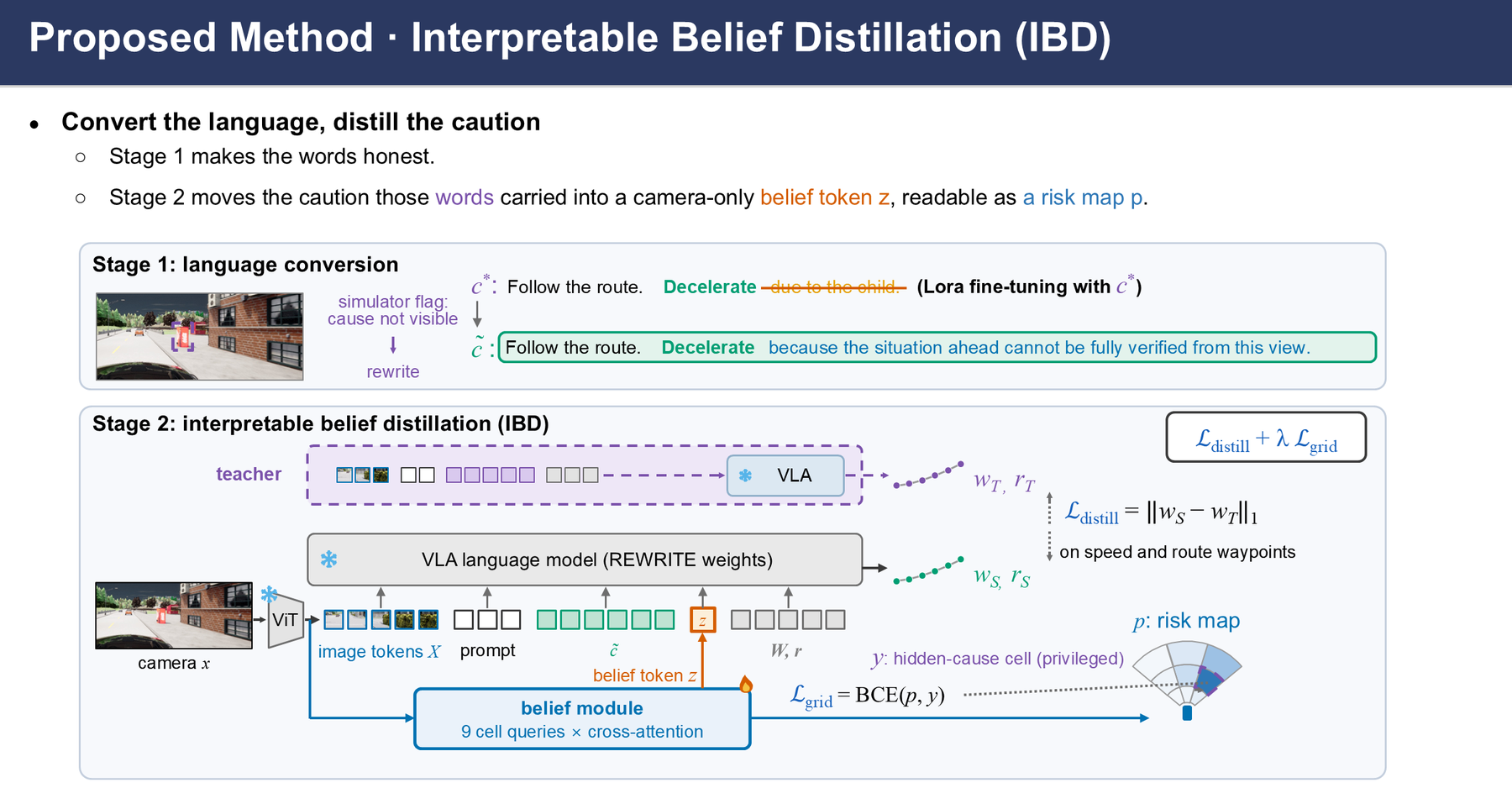
- Stage 1 · Language conversion. A cause the camera cannot verify is rewritten into an honest caution phrase, and the action verb is kept: “Decelerate due to the child.” → “Decelerate because the situation ahead cannot be fully verified from this view.” The VLA is fine-tuned on these sentences.
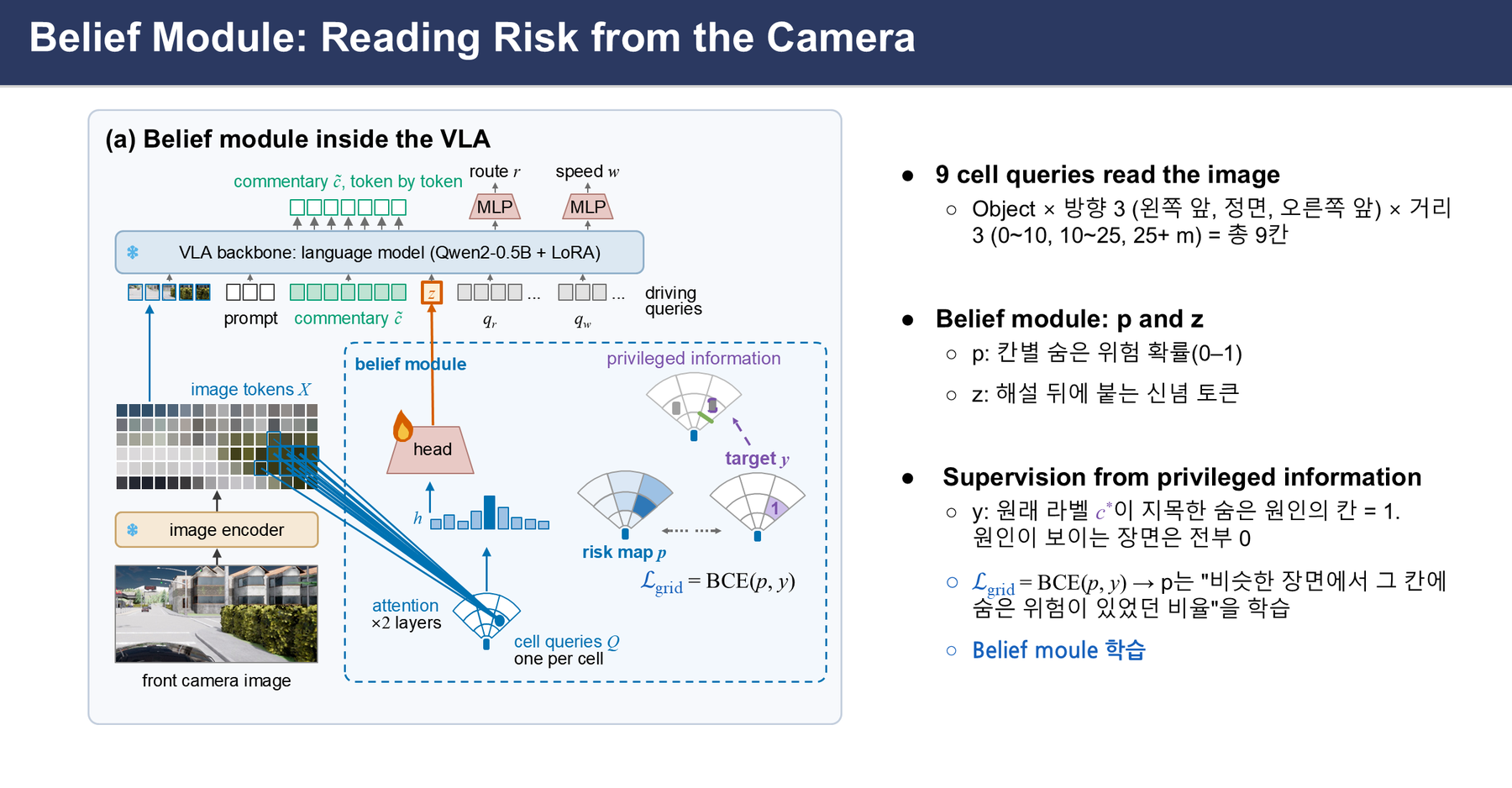
- Stage 2 · Belief distillation. The VLA is frozen. A belief module reads the camera's image tokens with one query per risk-map cell (object type × three directions × three distance ranges). It outputs a risk map p that people can read, and a belief token z placed after the commentary, so z changes the waypoints, not the words.
- Privileged teacher, camera-only student. The teacher is the same VLA given the original privileged sentence. The student's waypoints learn to follow the teacher's, and the risk map learns the hidden-cause cell from the simulator state. At test time the car uses the camera only.
- 1단계 · 언어 변환. 카메라로 확인할 수 없는 원인을 정직한 주의 문구로 바꾸고, 행동 동사는 그대로 둡니다: “Decelerate due to the child.” → “Decelerate because the situation ahead cannot be fully verified from this view.” 이 문장으로 VLA를 미세조정합니다.
- 2단계 · 신념 증류. VLA는 고정합니다. 신념 모듈은 위험 지도 칸마다 하나씩 있는 질의(대상 종류 × 방향 3 × 거리 3)로 카메라 이미지 토큰을 읽습니다. 사람이 읽을 수 있는 위험 지도 p와, 해설 뒤에 붙는 신념 토큰 z를 냅니다. 그래서 z는 문장이 아니라 경로점을 바꿉니다.
- 특권 교사, 카메라만 쓰는 학생. 교사는 같은 VLA에 원래 특권 문장을 넣은 것입니다. 학생의 경로점은 교사를 따라가도록, 위험 지도는 시뮬레이터 상태의 숨은 원인 칸을 맞히도록 학습합니다. 실제 주행에서는 카메라만 씁니다.
- 第 1 阶段 · 语言转换。把相机无法验证的原因改写为如实的提醒用语,同时保留动作动词:“Decelerate due to the child.” → “Decelerate because the situation ahead cannot be fully verified from this view.”,并用这些句子微调 VLA。
- 第 2 阶段 · 信念蒸馏。冻结 VLA。信念模块为风险地图的每个格子设一个查询(目标类型 × 3 个方向 × 3 个距离段),读取相机图像 token,输出人可读的风险地图 p,以及放在解说之后的信念 token z,因此 z 改变的是路径点而不是文字。
- 特权教师,仅用相机的学生。教师是输入原始特权句子的同一个 VLA。学生的路径点学习跟随教师,风险地图学习仿真状态中的隐藏原因格子。测试时车辆只使用相机。
Closed-loop driving videos폐루프 주행 영상闭环驾驶视频
Closed-loop runs in CARLA. The lower panel or box shows the model's own commentary; dots are the predicted path and speed waypoints. In IBD clips, the 3×3 grids at the top right are the risk map drawn by the agent itself while driving.CARLA 폐루프 주행입니다. 아래 패널(또는 상자)은 모델이 직접 쓴 해설이고, 점은 예측 경로·속도 경로점입니다. IBD 영상의 오른쪽 위 3×3 격자는 주행 중 에이전트가 직접 그린 위험 지도입니다.CARLA 中的闭环行驶。下方面板(或方框)是模型自己生成的解说;圆点为预测的路径与速度路径点。IBD 视频右上角的 3×3 网格是智能体在行驶中自己绘制的风险地图。
Risk map activation위험 상황 해설과 신념토큰 추가 후 리스크 맵 활성화意义与下一步
- Honest explanations are a safety property. In a driving VLA the commentary is also a command, so an explanation people can trust starts with sentences the camera can verify.
- Privileged information is safety knowledge. IBD keeps it as a teacher signal during training instead of putting it into the words.
- Two readable channels. IBD separates what the camera can verify (honest commentary) from where risk may come from (a camera-based risk map people can inspect).
- Next. Risk targets the camera can learn (events inside the view a few seconds later), training targets for the pedestrian cells, and the same hindsight rule on real driving logs.
- 정직한 설명은 안전의 일부입니다. 주행 VLA에서 해설은 명령이기도 하므로, 믿을 수 있는 설명은 카메라로 검증할 수 있는 문장에서 시작합니다.
- 특권 정보는 안전 지식입니다. IBD는 이 정보를 문장에 넣는 대신, 학습 때 교사 신호로 씁니다.
- 읽을 수 있는 두 개의 통로. IBD는 카메라로 검증할 수 있는 것(정직한 해설)과 위험이 올 수 있는 곳(사람이 확인할 수 있는 카메라 기반 위험 지도)을 분리합니다.
- 다음 단계. 카메라로 배울 수 있는 위험 정답(몇 초 뒤 시야 안에서 실제로 일어난 사건), 보행자 칸의 학습 정답, 그리고 같은 사후 규칙을 실제 주행 로그에 적용하는 것입니다.
- 如实的解释本身就是安全属性。在驾驶 VLA 中,解说同时也是指令,因此值得信任的解释要从相机能够验证的句子开始。
- 特权信息是安全知识。IBD 不把它写进句子,而是在训练时作为教师信号使用。
- 两个可读的通道。IBD 把相机能验证的内容(如实的解说)与风险可能来自哪里(人可检查的、基于相机的风险地图)分开。
- 下一步。相机可以学习的风险目标(几秒后在视野内真实发生的事件)、行人格子的训练目标,以及把同一事后规则用于真实驾驶日志。
Related: Route-Guided CBF-QP Repair, a safety layer for robot VLA policies.관련 프로젝트: 로봇 VLA 정책용 안전 계층 Route-Guided CBF-QP Repair.相关项目:面向机器人 VLA 策略的安全层 Route-Guided CBF-QP Repair。