
Weighted Contrastive Learning for Robust Audio-Visual Deepfake Detection
TL;DR
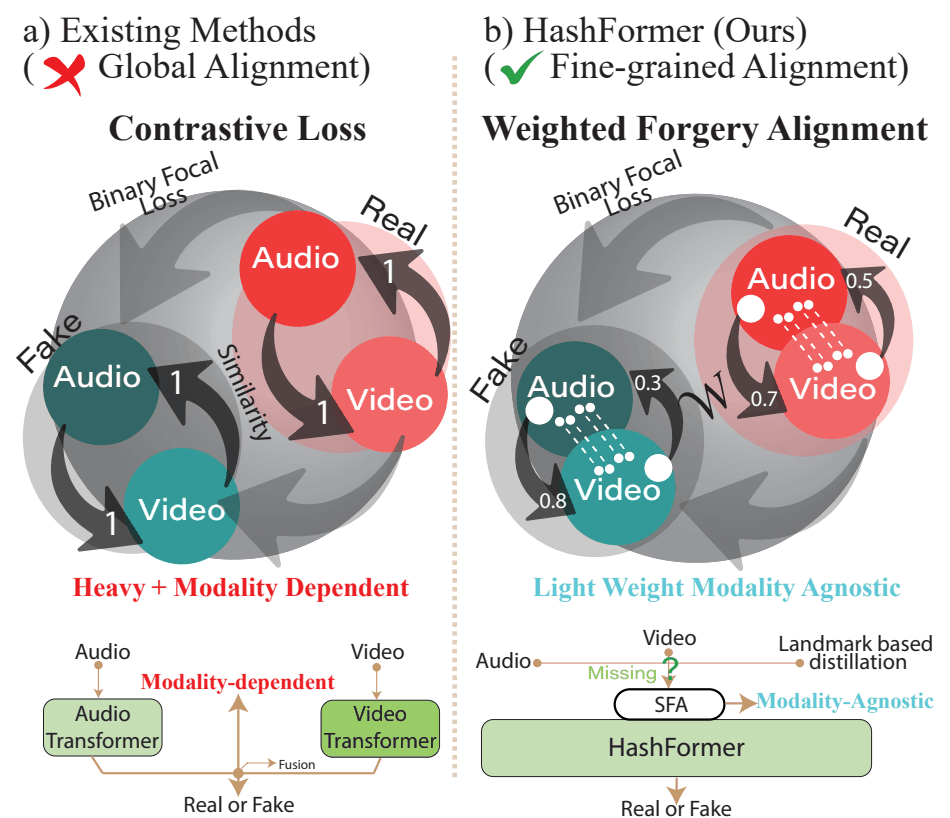
- Audio-visual deepfakes mix face swapping, lip-syncing and voice cloning; global alignment misses fine-grained local cues.
- HashFormer learns fine-grained cross- and within-modality features with a weighted contrastive-style loss in a binary hash space.
- Modality-specific tokens focus on unimodal clues. The model is designed to stay robust when a modality is missing.
- 음성-영상 딥페이크에는 얼굴 교체, 립싱크, 음성 복제가 섞여 있고, 전역 정렬은 세밀한 국소 단서를 놓칩니다.
- HashFormer는 이진 해시 공간의 가중 대조 학습형 손실로 모달리티 간·내부의 세밀한 특징을 학습합니다.
- 모달리티별 토큰으로 단일 모달리티 단서에 집중합니다. 한 모달리티가 빠져도 견고하도록 설계되었습니다.
- 音视频深度伪造混合了换脸、唇形同步和声音克隆;全局对齐会漏掉细粒度的局部线索。
- HashFormer 在二值哈希空间中用加权对比式损失,学习模态间与模态内的细粒度特征。
- 模态专属 token 聚焦单模态线索;模型设计上可在缺失某一模态时保持稳健。
Under review. This page summarizes the submitted abstract and shows the paper's figures. Authors, venue and results will be added after review. Anonymized code (HashFormer) is available for reviewers.
Problem
- Audio-visual deepfakes mix face swapping, lip-syncing, reenactment and voice cloning.
- Many detectors align audio and video with a standard contrastive loss on global features.
- That loss overlooks fine-grained local cues, such as facial attributes and acoustic patterns.
- Two-stream models fuse audio and video only at the end, so links within and across modalities are lost.
- Most multimodal detectors need every stream and cannot work when one is missing.
심사 중. 이 페이지는 제출본 초록을 요약하고 논문 그림을 보여 줍니다. 저자, 게재처, 결과는 심사 후 추가합니다. 심사용 익명 코드(HashFormer)가 공개되어 있습니다.
문제
- 음성-영상 딥페이크에는 얼굴 교체, 립싱크, 재연(reenactment), 음성 복제가 섞여 있습니다.
- 많은 탐지기는 표준 대조 손실로 오디오와 비디오의 전역 특징을 정렬합니다.
- 이 방식은 얼굴 속성이나 음향 패턴 같은 세밀한 국소 단서를 놓칩니다.
- 2-스트림 모델은 오디오와 비디오를 마지막에만 결합해, 모달리티 내부·간의 관계를 잃습니다.
- 대부분의 멀티모달 탐지기는 모든 스트림이 필요하고, 하나가 빠지면 동작하지 못합니다.
审稿中。本页概述投稿摘要并展示论文图示。作者、发表处和结果将在审稿结束后补充。已提供供审稿使用的匿名代码(HashFormer)。
问题
- 音视频深度伪造混合了换脸、唇形同步、表情重演(reenactment)和声音克隆。
- 许多检测器用标准对比损失对齐音频与视频的全局特征。
- 这种做法会忽略面部属性、声学模式等细粒度局部线索。
- 双流模型只在最后融合音频与视频,丢失了模态内与模态间的关系。
- 多数多模态检测器需要所有输入流,缺少其中一路就无法工作。
Approach
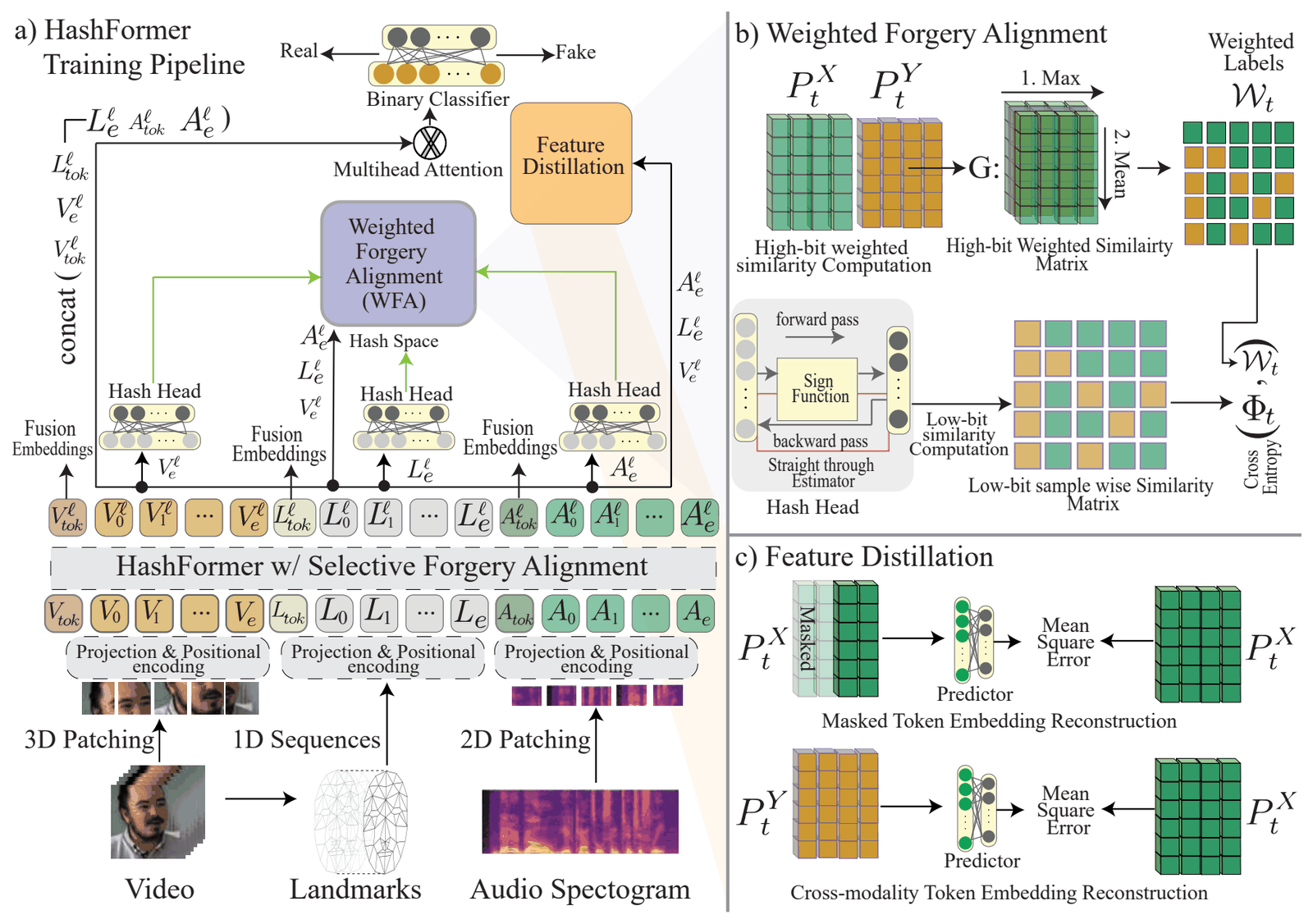
- One temporal transformer, three inputs: video frames (3D patches), facial landmarks from MediaPipe (1D sequences), and the audio spectrogram (2D patches).
- Weighted Forgery Alignment (WFA): a contrastive-like loss with weighted labels.
- It compares modality pairs in a binary hash space, which limits noise and outliers from high-bit embeddings.
- The weights favor forgery-relevant pairs, so global similarity does not dominate.
- Hash codes come from a sign function trained with a straight-through estimator.
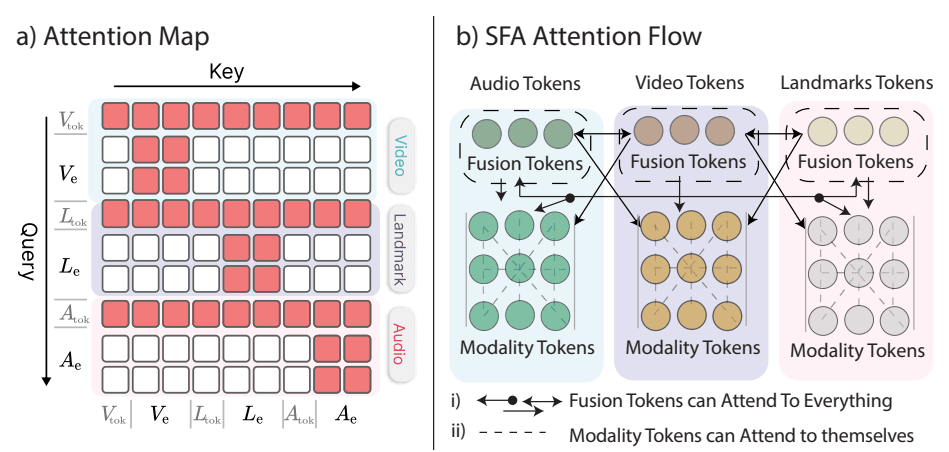
- Selective Forgery Alignment (SFA): a binary attention mask inside the transformer.
- Modality tokens attend only to their own modality.
- Fusion tokens attend to everything and learn cross-modal links.
- Feature distillation: the model reconstructs masked token embeddings and cross-modal token embeddings (MSE loss).
- Missing modalities: an absent stream becomes a zero-like token, and streams are dropped at random during training.
방법
- 세 입력을 받는 하나의 시간 트랜스포머: 비디오 프레임(3D 패치), MediaPipe 얼굴 랜드마크(1D 시퀀스), 오디오 스펙트로그램(2D 패치).
- Weighted Forgery Alignment (WFA): 가중 라벨을 쓰는 대조 학습형 손실입니다.
- 모달리티 쌍을 이진 해시 공간에서 비교해, 고비트 임베딩의 노이즈와 이상치 영향을 줄입니다.
- 가중치가 위조와 관련된 쌍을 우선하므로, 전역 유사도가 학습을 지배하지 않습니다.
- 해시 코드는 sign 함수로 만들고, straight-through estimator로 학습합니다.
- Selective Forgery Alignment (SFA): 트랜스포머 안의 이진 어텐션 마스크입니다.
- 모달리티 토큰은 자기 모달리티에만 어텐션합니다.
- 융합(fusion) 토큰은 모든 토큰에 어텐션하며 모달리티 간 관계를 학습합니다.
- 특징 증류: 마스킹된 토큰 임베딩과 모달리티 간 토큰 임베딩을 복원합니다(MSE 손실).
- 모달리티 결손 대응: 빠진 스트림은 zero-like 토큰으로 대체하고, 학습 중 스트림을 무작위로 제거합니다.
方法
- 一个时序 transformer,三路输入:视频帧(3D patch)、MediaPipe 面部关键点(1D 序列)和音频频谱图(2D patch)。
- Weighted Forgery Alignment(WFA):带加权标签的类对比损失。
- 在二值哈希空间中比较模态对,减少高比特嵌入中噪声和离群点的影响。
- 权重偏向与伪造相关的样本对,避免全局相似度主导学习。
- 哈希码由 sign 函数生成,并用 straight-through estimator 训练。
- Selective Forgery Alignment(SFA):transformer 内部的二值注意力掩码。
- 模态 token 只关注本模态。
- 融合(fusion)token 可关注全部 token,学习跨模态关系。
- 特征蒸馏:重建被遮挡的 token 嵌入和跨模态 token 嵌入(MSE 损失)。
- 模态缺失:缺失的输入流以近似零的 token 代替,训练时随机丢弃输入流。
Qualitative figures
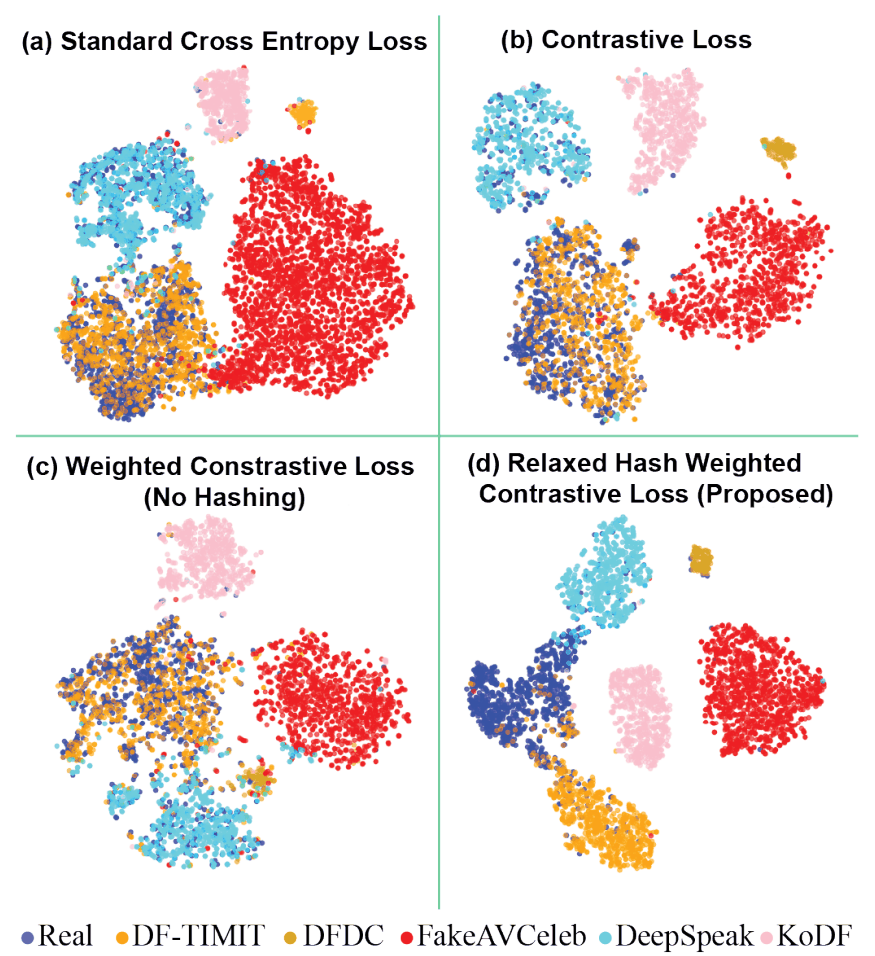
- Figure 4 compares learned features under four training losses, using t-SNE.
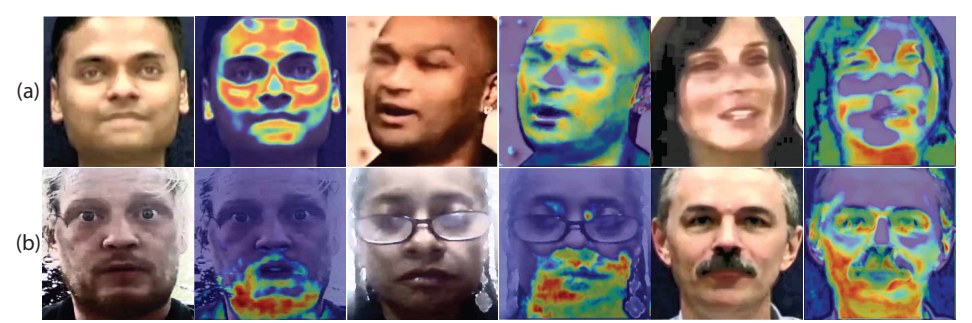
- Figure 5 shows where the video fusion tokens attend on face-swap and lip-sync samples.
정성적 그림
- 그림 4는 네 가지 학습 손실로 얻은 특징을 t-SNE로 비교합니다.
- 그림 5는 얼굴 교체·립싱크 샘플에서 비디오 융합 토큰이 어디에 어텐션하는지 보여 줍니다.
定性图示
- 图 4用 t-SNE 比较四种训练损失下学到的特征。
- 图 5展示在换脸和唇形同步样本上,视频融合 token 的注意力落在何处。