

LLM Agent Research Pipeline with Cross-Model Review
- A multi-agent research pipeline (open-source ARIS on Claude Code) is fast, but a model family reviewing its own output is unreliable.
- I wrote the research brief and built a cross-model reviewer harness (Gemini API, Codex CLI) with fallback and provenance logging.
- I kept the code-grounded reviewer's objections open, caught a reviewer error, and dropped a citation that failed an existence check.
- 멀티 에이전트 연구 파이프라인(Claude Code 위 오픈소스 ARIS)은 빠르지만, 같은 모델 계열의 자기 평가는 믿기 어렵습니다.
- 연구 브리프를 작성하고, 폴백과 출처 기록을 갖춘 교차 모델 리뷰어 하네스(Gemini API, Codex CLI)를 만들었습니다.
- 코드 기반 리뷰어의 지적을 열린 이슈로 유지하고, 리뷰어 오류를 잡았으며, 존재 확인에 실패한 인용을 뺐습니다.
- 多智能体研究流程(Claude Code 上的开源 ARIS)速度快,但同一模型族自评并不可靠。
- 我撰写了研究需求说明,并搭建了带回退与来源记录的跨模型评审框架(Gemini API、Codex CLI)。
- 我保留了基于代码的评审者提出的问题,发现了一处评审错误,并删去一条无法核实其存在的引用。
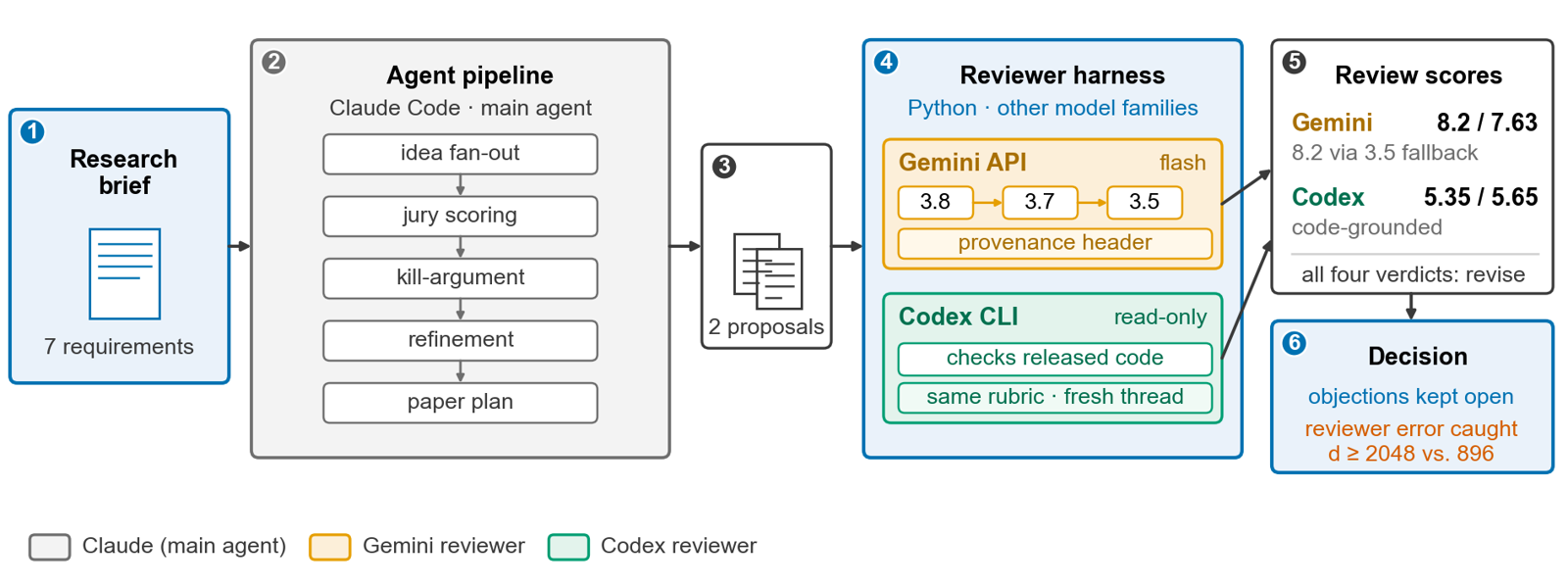
Personal project, Sep. 2026. Built on the open-source ARIS skill pack, with Claude Code as the main agent. ARIS takes a brief through idea fan-out, jury scoring, kill-argument, refinement and paper-plan stages.
SSituation
A multi-agent pipeline drafts research ideas and paper plans fast. But when one model family judges its own output, the review is easy to over-trust.
TTask
Give the pipeline a precise brief. Add an independent, auditable review stage from other model families.
AAction
- Wrote the 7-requirement research brief, the only input to every agent run.
- Built a Python cross-model-family reviewer harness:
- Gemini API reviewer; the API key is read from an env file, not code.
- Automatic fallback across 3 models with back-off retries.
- A provenance header recording which model actually answered.
- Added Codex CLI (read-only) as a second reviewer. It checks claims against the target model's released code.
RResult
- The provenance header revealed the real reviewer: draft 1 went to a lighter fallback Gemini model, because the first-choice models were overloaded.
- Flash-tier Gemini reviewers scored the two drafts 8.2 and 7.63, both REVISE. Codex, checking against the released code, gave 5.35 and 5.65 (no pass).
- I kept Codex's objections marked OPEN instead of reporting the higher score.
- I caught a reviewer error (claimed hidden size of at least 2048; actual 896) and dropped a recommended citation that failed an existence check.
- Skills practised: LLM agents, multi-agent orchestration, Claude Code, Codex CLI, Gemini API, MCP servers, evaluation and provenance logging, LLM-as-a-judge reliability.
개인 프로젝트, 2026년 9월. Claude Code용 오픈소스 ARIS 스킬 팩 위에서 진행했고, 메인 에이전트는 Claude Code입니다. ARIS는 브리프를 아이디어 확장, 심사 점수화, 반론(kill-argument), 개선, 논문 계획 단계로 처리합니다.
S상황
멀티 에이전트 파이프라인은 연구 아이디어와 논문 계획을 빠르게 만듭니다. 하지만 한 모델 계열이 자기 결과물을 평가하면 그 리뷰를 과신하기 쉽습니다.
T과제
파이프라인에 명확한 브리프를 주고, 다른 모델 계열의 독립적이고 추적 가능한 리뷰 단계를 추가합니다.
A행동
- 모든 에이전트 실행의 유일한 입력인 7개 요구사항의 연구 브리프를 작성했습니다.
- Python으로 교차 모델 계열 리뷰어 하네스를 만들었습니다.
- Gemini API 리뷰어. API 키는 코드가 아닌 env 파일에서 읽습니다.
- 3개 모델 간 자동 폴백과 백오프 재시도.
- 실제로 답한 모델을 기록하는 출처 헤더.
- 두 번째 리뷰어로 Codex CLI(읽기 전용)를 추가했습니다. 대상 모델의 공개 코드와 주장을 대조합니다.
R결과
- 출처 헤더로 실제 리뷰어를 확인했습니다. 1순위 모델들이 과부하여서 초안 1은 더 가벼운 폴백 Gemini 모델이 리뷰했습니다.
- flash급 Gemini 리뷰어는 두 초안에 8.2점과 7.63점(둘 다 REVISE)을 주었습니다. 공개 코드와 대조한 Codex는 5.35점과 5.65점(통과 아님)이었습니다.
- 더 높은 점수를 보고하는 대신 Codex의 지적을 OPEN으로 유지했습니다.
- 리뷰어 오류(hidden size가 2048 이상이라는 주장, 실제 896)를 잡고, 존재 확인에 실패한 추천 인용을 뺐습니다.
- 다룬 기술: LLM 에이전트, 멀티 에이전트 오케스트레이션, Claude Code, Codex CLI, Gemini API, MCP 서버, 평가·출처 로깅, LLM-as-a-judge 신뢰도.
个人项目,2026年9月。基于 Claude Code 的开源 ARIS 技能包,主 agent 为 Claude Code。ARIS 将研究需求说明依次送入创意发散、评审打分、反驳论证(kill-argument)、改进和论文规划等阶段。
S情境
多智能体流程能快速产出研究创意和论文规划。但同一模型族评审自身产出时,评审结果容易被过度信任。
T任务
为流程提供明确的需求说明,并加入由其他模型族执行、独立且可追溯的评审环节。
A行动
- 撰写包含 7 项要求的研究需求说明,作为每次智能体运行的唯一输入。
- 用 Python 搭建跨模型族评审框架:
- Gemini API 评审者;API key 从 env 文件读取,而不写在代码中。
- 在 3 个模型间自动回退,并带退避重试。
- 来源记录头,标明实际作答的模型。
- 加入 Codex CLI(只读)作为第二评审者,对照目标模型公开的代码核查论断。
R结果
- 来源记录头揭示了真实评审者:首选模型过载,第 1 份草稿由更轻量的回退 Gemini 模型评审。
- flash 级 Gemini 评审者给两份草稿打出 8.2 和 7.63 分,结论均为 REVISE;对照公开代码核查的 Codex 给出 5.35 和 5.65 分(未达标)。
- 我没有报告更高的分数,而是把 Codex 的问题保持为 OPEN。
- 发现一处评审错误(声称 hidden size 至少为 2048,实际为 896),并删去一条无法核实其存在的推荐引用。
- 涉及技能:LLM 智能体、多智能体编排、Claude Code、Codex CLI、Gemini API、MCP 服务器、评估与来源记录、LLM-as-a-judge 可靠性。