

Part 5 · Borrowing from VLAs: action tokens and action chunks5편 · VLA에서 빌려 온 것: 액션 토큰과 액션 청크第 5 篇 · 向 VLA 借鉴:动作 token 与动作块
Published:
Series Building and Evaluating a Drone VLA from Scratch드론 VLA를 처음부터 만들고 평가하기从零构建并评估无人机 VLA Season 2 · Part 5 of 13
One question runs through it: if you change only the words, does the drone fly somewhere else? CPU-first, in simulation. Seasons 1–3 use a small language-conditioned policy trained from scratch; the pretrained VLA (SmolVLA) arrives in Season 4.관통하는 질문은 하나입니다: 말만 바꾸면 드론이 다른 곳으로 날아갈까? CPU 우선, 시뮬레이션에서 진행합니다. 시즌 1–3은 처음부터 학습한 작은 language-conditioned 정책을, 시즌 4에서 사전학습 VLA(SmolVLA)를 다룹니다.贯穿全系列的问题只有一个:只改变指令文字,无人机会飞向别处吗?以 CPU 为先,在仿真中进行。第 1–3 季使用从零训练的小型 language-conditioned 策略,第 4 季引入预训练 VLA(SmolVLA)。 Code
Season 1 · Make the question testable
- Fast frames, missing targets: a drone simulator on a laptop CPU
- From a real drone's spec sheet to a testable task
- Same scene, different words: a counterfactual dataset
- The policy that did not listen
Season 2 · Find out what the result means
- Borrowing from VLAs: action tokens and action chunks
- Separating perception from choice: a world model and a planner
Season 3 · Change the system, keep the behaviour
- One evaluation contract for Python and C++ (coming)
- What changes when the policy runs in ONNX and INT8? (coming)
- A C++ inference runner, measured end to end (coming)
- Turning evaluation into a release gate (coming)
Season 4 · Change the model, close the data loop
- Adapting SmolVLA to a drone (coming)
- Which failures should become the next dataset? (coming)
- Taking the evaluation contract into ROS 2 and PX4 (coming)
- Only the action head and its loss changed; no pretrained model. 256-bin action tokens (as in OpenVLA) raised success from 3/20 to 8/20 and cut the median final distance from 1.38 m to 0.22 m.
- Why: on the frame where only the words decide, regression answers between the two sentences' answers. A token head puts its probability mostly on one of them, although not always the right one (right in 135 of 200 training frames).
- An 8-step action chunk, executed one step at a time, is the best end-to-end model so far: 4 of 10 validation pairs split to the right targets, pair success 3/10 (95% interval 0.11–0.60, one training seed). Adding exploration states makes it react to the words like the expert on training frames, but in flight 8 of 20 runs overshoot and leave the room.
- 바뀐 것은 행동 출력 헤드와 그 손실뿐이고 사전학습 모델은 없습니다. 256개 구간 액션 토큰(OpenVLA 방식)으로 성공이 3/20에서 8/20으로 오르고 최종 거리 중앙값이 1.38 m에서 0.22 m로 줄었습니다.
- 이유: 말만이 방향을 정하는 프레임에서 회귀는 두 문장의 정답 사이를 답합니다. 토큰 헤드는 확률을 대부분 둘 중 하나에 겁니다. 다만 늘 맞는 쪽은 아닙니다(학습 프레임 200개 중 135개에서 맞는 쪽).
- 한 스텝씩 실행하는 8스텝 액션 청크가 지금까지 가장 나은 end-to-end 모델입니다: 검증 10쌍 중 4쌍이 맞는 타깃으로 갈라졌고 쌍 성공 3/10(95% 구간 0.11–0.60, 학습 시드 1개). 탐색 상태를 더하면 학습 프레임에서는 전문가만큼 말에 반응하지만 실제 비행에서는 20번 중 8번이 목표를 지나쳐 방 밖으로 나갑니다.
- 只改变了动作输出头和它的损失,没有预训练模型。256 档动作 token(OpenVLA 的做法)使成功率从 3/20 升至 8/20,最终距离中位数从 1.38 m 降到 0.22 m。
- 原因:在只有指令能决定方向的那一帧,回归给出两句指令答案之间的值;token 头则把概率主要放在其中一个上,但不总是对的那个(200 个训练帧中 135 个是对的)。
- 逐步执行的 8 步动作块是目前最好的端到端模型:10 个验证对中 4 个分别飞向正确目标,pair 成功 3/10(95% 区间 0.11–0.60,单个训练种子)。加入探索状态后,它在训练帧上对指令的反应达到专家水平,但实际飞行中 20 次有 8 次冲过目标飞出房间。
正文为英文,图表与代码与语言无关。
Part 4 ended with a diagnosis. The words matter on one frame per episode, the first, which is 2% of the training rows. On that frame the policy answered with the average of the two sentences’ answers. On every other frame the image already showed where to go.
Large vision-language-action models (VLAs) don’t output actions the way that policy did. RT-2 and OpenVLA turn each action dimension into one of 256 tokens and train with cross-entropy. OpenVLA-OFT and ACT predict a chunk of several future actions at once. This post borrows those two output formats and nothing else. The encoders keep their design, the data and the parameter budget stay as they were, and the image layer shrinks from 128 to 104 numbers to keep the parameter counts comparable. There is still no pretrained model; that arrives in Season 4.
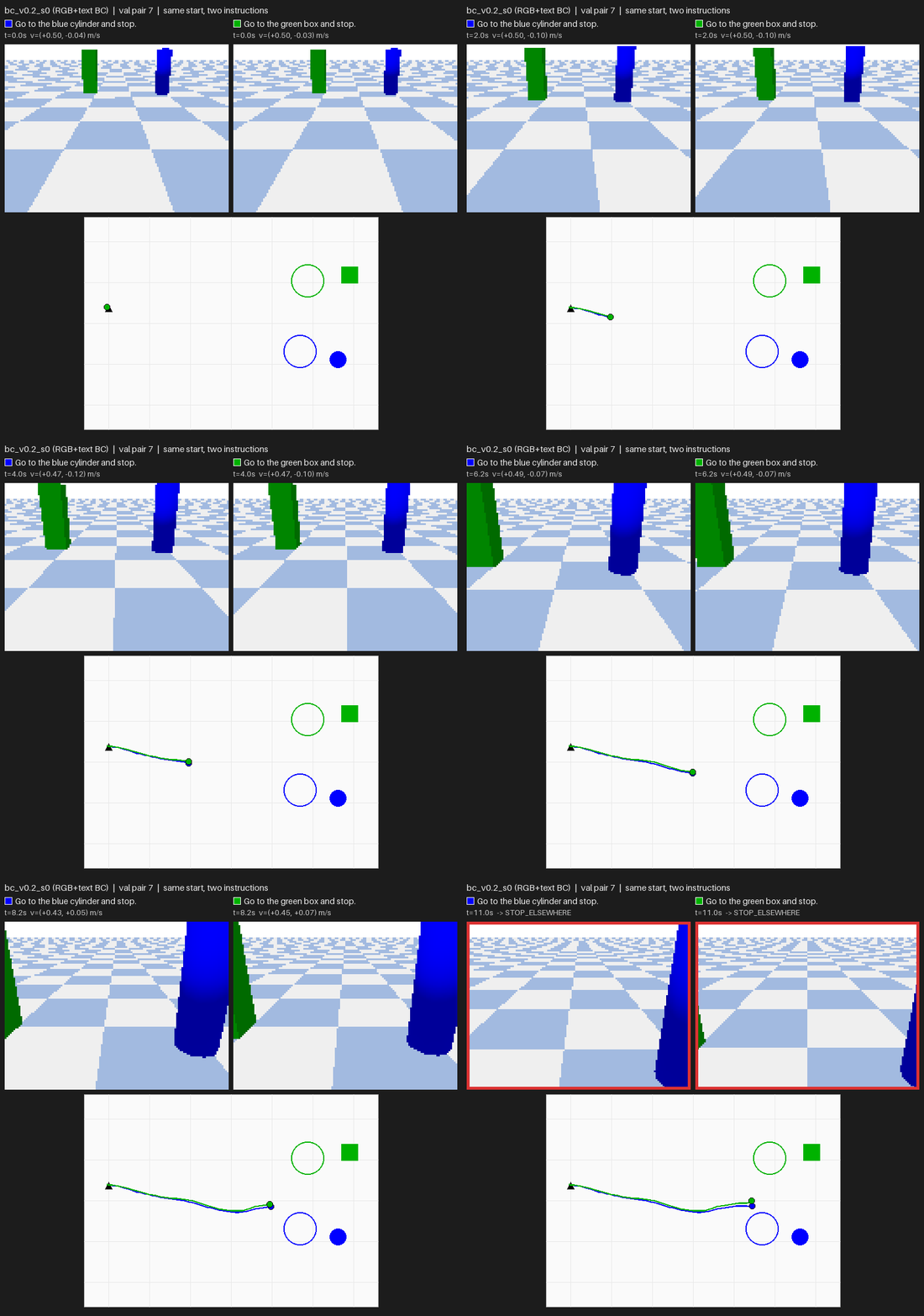
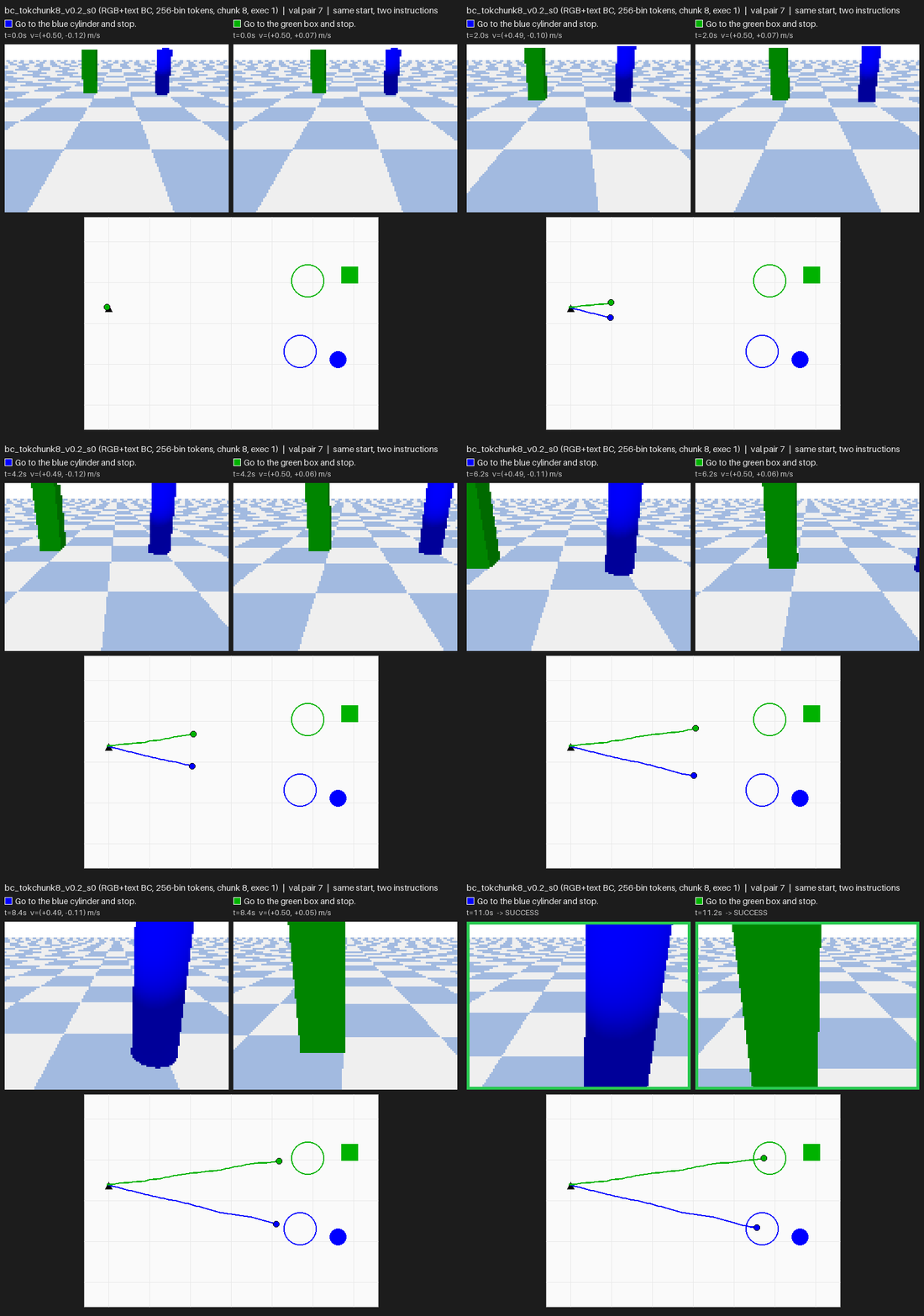
How these experiments were run
This post is a screen, not a final result, so the rules are lighter than Part 4’s and are stated up front:
- One training seed per model (seed 0). Part 4 used three.
- Validation only: 10 pairs, 20 flights. The test split is untouched.
- Same training recipe as Part 4: 20 epochs, keep the last, dataset v0.2 (100 training pairs).
- Same size: every model has 80–100% of Part 4’s 480,901 parameters.
Single-pair differences are noise at this sample size, so the post gives intervals where it matters.
1. What changed: only the output
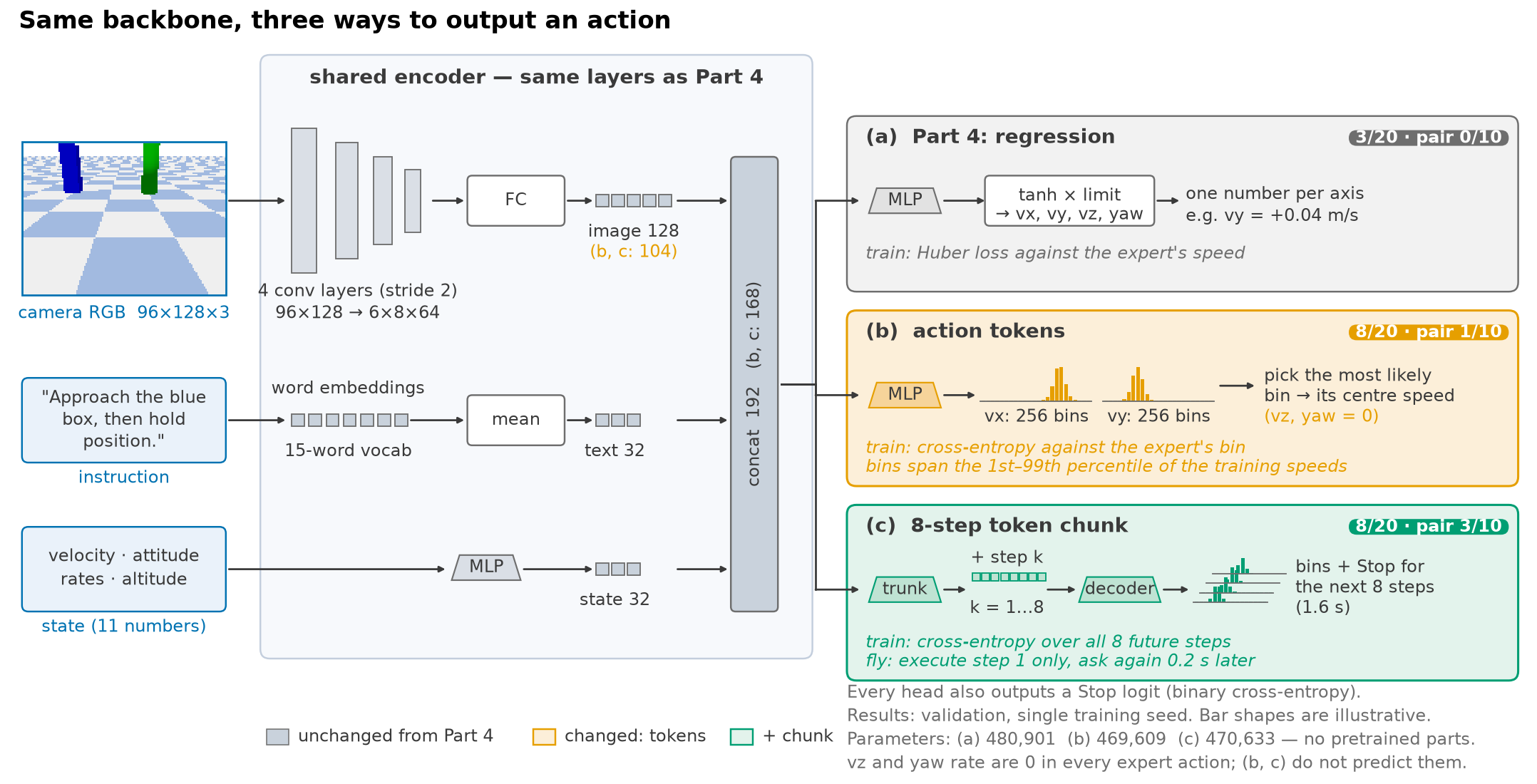
Tokens. For each axis, the training speeds are split into 256 equal bins between their 1st and 99th percentiles, as OpenVLA does. The head outputs 256 scores per axis instead of one number. Training asks it to score the expert’s bin highest (cross-entropy); flying uses the centre of its top bin (model code):
def set_action_bins(self, actions):            # actions: (N, 4) training speeds / limits
    for i, d in enumerate((0, 1)):             # vx, vy; vz and yaw rate are always 0 here
        lo, hi = torch.quantile(actions[:, d], torch.tensor([0.01, 0.99]))
        self.bin_edges[i] = torch.linspace(lo, hi, 257)

def tokenize(self, actions):                   # training target: which bin
    return torch.stack([torch.bucketize(actions[:, d], self.bin_edges[i, 1:-1])
                        for i, d in enumerate((0, 1))], dim=1)

def detokenize(self, logits):                  # flying: the centre of the most likely bin
    centres = (self.bin_edges[:, :-1] + self.bin_edges[:, 1:]) / 2
    return centres.gather(1, logits.argmax(-1).T).T
Chunks. The head predicts the next 8 steps at once. A shared trunk produces one feature, a learned embedding for each step k is added, and one decoder turns each into bins plus a Stop logit. The loss covers every future step that exists in the episode (training code):
logits_h, stops_h = model.heads(feats)[2]          # (B, 8, 2, 256), (B, 8)
target = model.tokenize(chunk_action[idx])         # expert's next 8 actions, as bins
ce = cross_entropy(logits_h.flatten(0, 2), target.flatten(), reduction="none")
motion = (ce.view(B, 8, 2).mean(-1) * mask).sum() / mask.sum()   # mask: steps past the end
stop = (bce(stops_h, chunk_stop[idx]) * mask).sum() / mask.sum()
loss = motion + stop
The model is still asked every 0.2 s, and only the first step is flown. So the chunk changes what the model is trained to predict, not how it flies. Section 3 also tests flying all 8 steps.
2. Why tokens fly better: averaging versus choosing
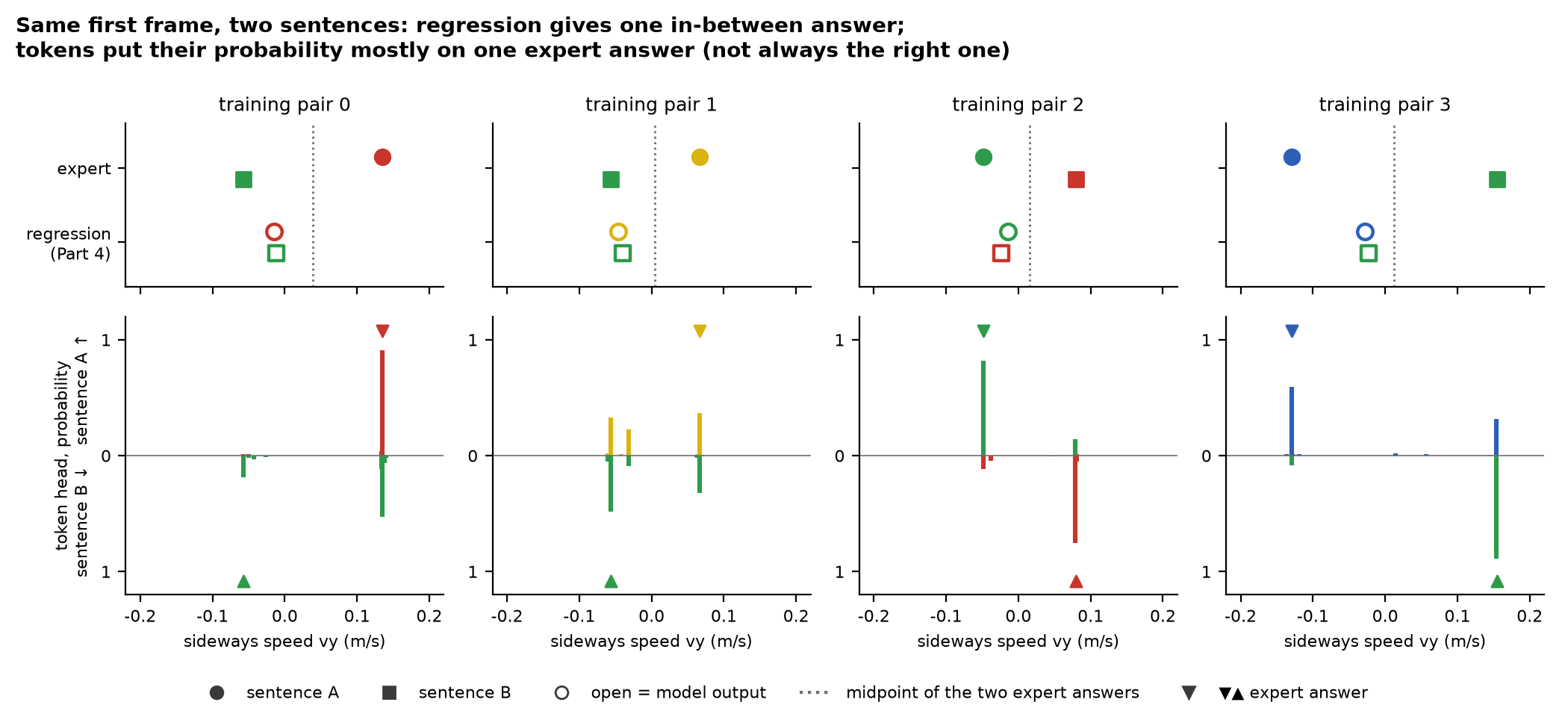
On the first frame, the image and the state are identical for both sentences of a pair, and their labels differ. Regression with a Huber loss is pulled toward the middle. Over all 200 training first frames, the Part 4 model is closer to its own sentence’s answer in exactly 100 and to the other sentence’s answer in the other 100. It sits on average 0.03 m/s from the midpoint.
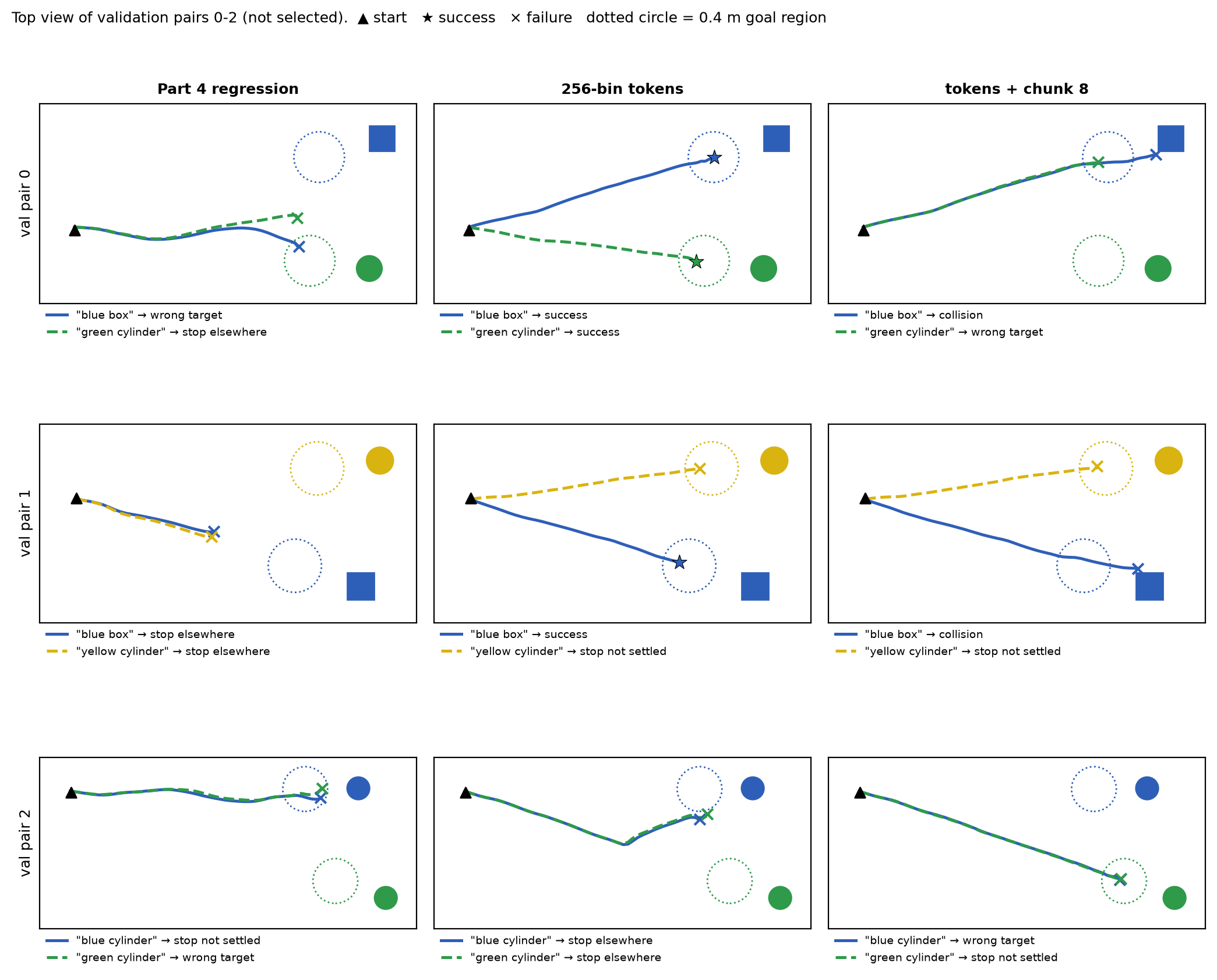
A token head can’t place its answer between two bins it was never shown. It has to put its probability somewhere, and it mostly puts it on one expert answer. It picks the right one in 135 of 200 training first frames. Its median error is 0.0005 m/s, but its mean is 0.066 m/s, because the wrong picks are a whole answer away. Training pair 0, sentence B in the figure is such a wrong pick.
In flight, a regression policy that starts in the middle tends to hover between the pillars. A token policy commits to a side. That alone moves the numbers:
| validation, 20 flights | Part 4 regression | 256-bin tokens |
|---|---|---|
| success | 3 | 8 |
| median distance to the named target at the end | 1.38 m | 0.22 m |
| stopped away from both targets | 8 | 3 |
| first frames where swapping the sentence changes vy by > 0.02 m/s (of 200 training frames) | 0 | 74 |
This is the multimodality problem that Diffusion Policy and Behavior Transformers were built for: when two answers are both right, a model that averages them is wrong for both. Here the two answers come from two sentences rather than from two demonstrators, but the loss can’t tell the difference on that frame.
3. Results: the chunk is the best end-to-end model so far
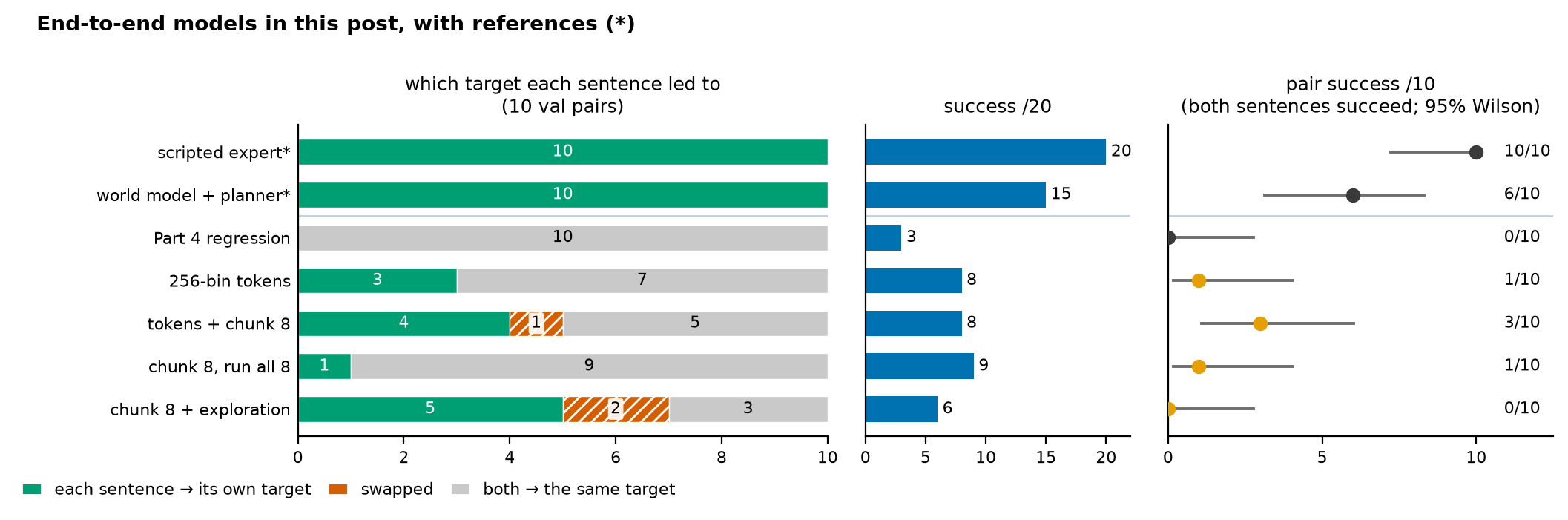
- Tokens alone don’t make the drone choose. With 256 bins, 7 of 10 pairs still go to the same pillar for both sentences. The token head commits, but on most first frames it commits to whatever the image suggests.
- Tokens + an 8-step chunk is the best end-to-end model: 4 pairs split the right way, and pair success is 3/10. One plausible reason: predicting 1.6 s ahead forces the representation to encode where the flight is going, not just the next step. Its 95% interval is 0.11–0.60, which overlaps Part 4’s 0/10 (0–0.28). With one seed and ten pairs this is a lead, not a proven gain.
- Flying all 8 predicted steps before asking again flies about as well (9/20) but listens less (1 correct pair). My guess: re-asking every step lets each new image correct the course, and flying 8 steps blind gives that up.
The first three validation pairs, unselected, show how far from solved this is:
4. More states: it reacts, then it can’t stop
Part 4’s diagnosis was that the words decide only on frames the policy rarely sees. Part 6’s world model was trained on three times as many states: expert flights plus exploration flights (noisy expert, random walks, overshoots past the goal). So I gave the chunk policy the same 400 exploration flights (19,896 states), each state labelled with what the expert would do from there toward a target picked at random for that episode, with the matching sentence. For exploration rows only the current step is a label; their future chunk steps are masked, because a random walk isn’t the expert’s plan.
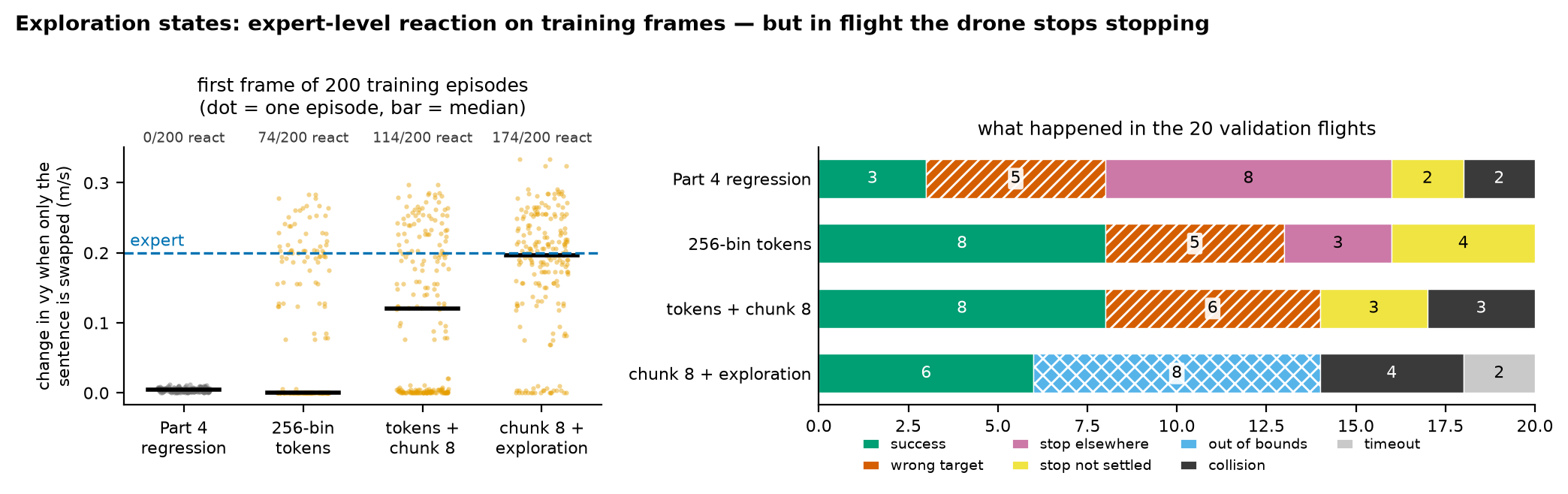
On training frames, the swap test now looks like the expert. Changing only the sentence moves the first command by a median 0.196 m/s (the expert: 0.200), and it moves in the right direction in 180 of 200 frames. In closed loop it splits 5 of 10 pairs the right way, the most of any end-to-end model (cross-attention + counterfactual relabelling also reaches 5). But 8 of 20 flights overshoot the target and leave the room, success falls to 6, and pair success is 0.
I didn’t separate the causes. Three candidates:
- Stop is diluted. The exploration rows contain only 6 Stop examples, so Stop becomes a rarer event in the training mix.
- The bins got coarser. The bin range comes from the training speeds, and exploration widens the vy range from about ±0.17 to ±0.42 m/s. Each bin is 2.4 times wider, which is coarse near the goal.
- Recovery labels near the goal. Overshoot flights teach large corrections exactly where the expert usually slows down.
With exploration states the first-frame reaction matched the expert’s on training frames (median 0.196 vs 0.200 m/s), but pair success fell from 3/10 to 0/10. The experiment changes what the policy reacts to without changing how it stops. That split, choosing versus flying, is what Part 6 builds in on purpose.
What this part does not show
- One training seed and ten pairs. Wilson 95% for 3/10 is 0.11–0.60. Single-pair differences, and the bin-count comparison in the appendix, are within noise.
- Validation was used both to screen models and to set the Stop threshold, so these are not generalisation estimates. The original test seeds were seen in an earlier round; final numbers need a fresh test split.
- The swap test runs on training frames. Near-zero token errors there may partly be memorisation.
- The language is easy. The two pillars always differ in colour, so one word decides.
- It is not a VLA. Only the output format is borrowed; there is no pretrained vision or language model.
Next
No end-to-end model splits more than 5 of 10 pairs the right way, and the best one completes 3. Part 6 tries the opposite design: a model that perceives where every target is without reading the words, a tiny selector that lets the words pick one, and a planner that flies there.
Appendix
A. Everything else I tried (validation, one seed)
| model | params | correct / swapped / same-target pairs | success /20 | pair success /10 |
|---|---|---|---|---|
| Part 4 regression | 480,901 | 0 / 0 / 10 | 3 | 0 |
| + counterfactual relabelling | 480,901 | 2 / 3 / 5 | 0 | 0 |
| + counterfactual + FiLM | 492,517 | 4 / 3 / 3 | 0 | 0 |
| + target-position aux head | 493,773 | 0 / 0 / 10 | 8 | 0 |
| + cross-attention | 420,997 | 0 / 0 / 10 | 0 | 0 |
| + cross-attention + counterfactual | 420,997 | 5 / 3 / 2 | 0 | 0 |
| 256-bin tokens | 469,609 | 3 / 0 / 7 | 8 | 1 |
| 64-bin tokens | 471,289 | 1 / 1 / 8 | 7 | 1 |
| 1024-bin tokens | 475,609 | 2 / 0 / 8 | 4 | 0 |
| 256-bin + paired goal loss | 480,555 | 2 / 0 / 8 | 7 | 0 |
| 256-bin + cross-attention | 477,289 | 1 / 0 / 9 | 9 | 0 |
| 256-bin + chunk 8, fly step 1 | 470,633 | 4 / 1 / 5 | 8 | 3 |
| 256-bin + chunk 8, fly all 8 | 470,633 | 1 / 0 / 9 | 9 | 1 |
| chunk 8 + exploration states | 470,633 | 5 / 2 / 3 | 6 | 0 |
| chunk 8 + exploration + aux head | 468,909 | 5 / 2 / 3 | 2 | 0 |
Notes:
- Counterfactual relabelling adds, for every training state, the expert's action toward the other target with the other sentence. The words start to matter, but correct and swapped pairs are about equal, and flying collapses. Part of that is a confound: the added rows contain no Stop positives, while the Stop loss weight stayed at its original value.
- Aux head: an extra output trained to predict where every colour's target is, from the simulator's true positions (the same labels Part 6's world model gets). It flies better (8/20) and listens no more.
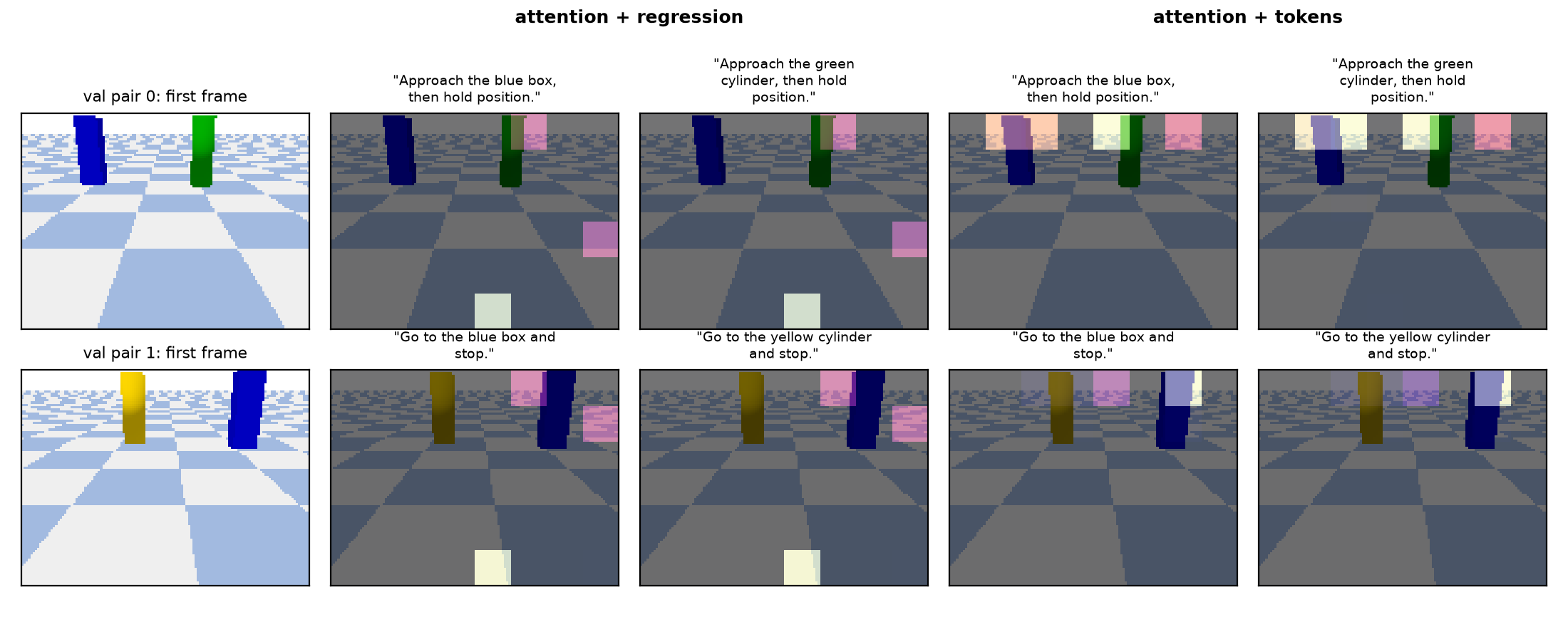
- FiLM and cross-attention let the sentence modulate the image features (FiLM scales and shifts the convolution channels; cross-attention uses the sentence as a query over 6 × 8 image patches). The FiLM row and the aux-head row predate the 80–100% parameter rule (FiLM 102%, aux 103%).
- Bin count: 64, 256 and 1024 bins are within one seed's noise of each other.
B. Reproduce
Commit 7b9acb9, dataset v0.2 from Part 3, exploration flights from python -m dronevla.explore.
python -m dronevla.train --data data/v0.2 --epochs 20 --select last --seed 0 \
    --action-bins 256 --img-dim 104 --out runs/bc_tok256_v0.2_s0
python -m dronevla.train --data data/v0.2 --epochs 20 --select last --seed 0 \
    --action-bins 256 --img-dim 104 --chunk 8 --out runs/bc_tokchunk8_v0.2_s0
python -m dronevla.train --data data/v0.2 --epochs 20 --select last --seed 0 \
    --action-bins 256 --img-dim 104 --chunk 8 --explore data/explore_v0.2/train \
    --out runs/bc_tokchunk8_explore_v0.2_s0
bash scripts/run_tokens_s0.sh && bash scripts/run_tokens2_s0.sh   # evaluate (and train if missing)
bash scripts/run_explore_s0.sh
python scripts/season2_summary.py                 # every number in this post (needs all run_*_s0.sh)
python scripts/figures/blog05.py                  # figures
bash scripts/figures/render_blog05_videos.sh      # GIFs
All screening runs: scripts/run_*_s0.sh. Full write-up: docs/season2_experiments.md.
References: what I took from each
- OpenVLA (Kim et al., 2024) and RT-2 (Brohan et al., 2023) discretise each action dimension into 256 bins and predict them as tokens. → The token head and its 1st–99th percentile bins.
- OpenVLA-OFT (Kim, Finn and Liang, 2025) and ACT (Zhao et al., 2023) predict chunks of future actions. → The 8-step chunk. Here only the first step is flown.
- Diffusion Policy (Chi et al., 2023) and Behavior Transformers (Shafiullah et al., 2022) show that averaging a multimodal action distribution fails. → The explanation for section 2.
- Stop Regressing (Farebrother et al., 2024) finds classification losses train value networks better than regression. → Why switching the loss alone was worth testing.
- Causal Confusion in Imitation Learning (de Haan et al., 2019) describes policies that latch onto the wrong cue. → The image shortcut from Part 4, which tokens don’t remove.
Summary (STAR)
SSituation
In Part 4 the regression policy answered with the average of the two sentences’ answers on the first frame, the only frame where the words decide (2% of the training rows). On validation it split 0 of 10 pairs and succeeded in 3 of 20 flights.
TTask
Find out whether borrowing only the output formats of VLAs, action tokens and action chunks, fixes this with the same encoder design, the same dataset v0.2, 80–100% of Part 4’s 480,901 parameters and no pretrained model. The image projection shrank from 128 to 104 outputs to keep the parameter counts comparable. This was a screen: one training seed, validation only.
AAction
I replaced the regression head with 256 bins per axis trained with cross-entropy, then added an 8-step (1.6 s) chunk head that is flown one step at a time. I also tried flying all 8 steps and adding 400 exploration flights (19,896 states), and measured each model with the sentence swap test and 20 closed-loop flights, with Wilson intervals.
RResult
Tokens raised success from 3/20 to 8/20 and cut the median final distance from 1.38 m to 0.22 m. Tokens plus the chunk split 4 of 10 pairs the right way, with pair success 3/10 (95% interval 0.11–0.60, overlapping Part 4’s 0–0.28): a lead, not a proven gain. Exploration states made the swap reaction match the expert (0.196 vs 0.200 m/s), but 8 of 20 flights overshot and left the room, and pair success fell to 0.
4편은 진단으로 끝났습니다. 말이 의미를 갖는 프레임은 에피소드마다 하나, 첫 프레임뿐이고 학습 행으로 치면 2%입니다. 그 프레임에서 정책은 두 문장 정답의 평균을 답했습니다. 나머지 프레임에서는 어디로 갈지 이미지가 이미 알려 주고 있었습니다.
대형 비전-언어-행동 모델(vision-language-action model, VLA)은 그 정책처럼 행동을 출력하지 않습니다. RT-2와 OpenVLA는 행동의 각 차원을 256개 토큰 중 하나로 바꾸고 cross-entropy로 학습합니다. OpenVLA-OFT와 ACT는 앞으로 할 행동 여러 개를 한 덩어리, 곧 청크로 한 번에 예측합니다. 이번 글은 이 두 출력 형식만 빌려 옵니다. 인코더의 기본 구조와 데이터, 파라미터 예산은 그대로 두고 파라미터 수를 비슷하게 맞추려고 이미지 층의 출력만 숫자 128개에서 104개로 줄입니다. 사전학습 모델은 이번에도 쓰지 않습니다. 그건 시즌 4의 몫입니다.
실험 방식
이번 글은 최종 결과가 아니라 후보를 걸러 보는 스크리닝입니다. 그래서 규칙을 4편보다 가볍게 잡았고 그 내용을 먼저 밝혀 둡니다.
- 모델마다 학습 시드 하나(시드 0). 4편은 세 개를 썼습니다.
- 검증 데이터만 씁니다. 10쌍, 비행 20회입니다. 테스트 분할은 건드리지 않았습니다.
- 학습 방식은 4편과 같습니다. 20 epoch, 마지막 모델 사용, 데이터셋 v0.2(학습 쌍 100개).
- 크기도 맞췄습니다. 모든 모델의 파라미터 수는 4편 480,901개의 80–100%입니다.
이 정도 표본에서는 쌍 하나 차이가 잡음에 묻힙니다. 그래서 중요한 곳에는 구간을 같이 적었습니다.
1. 바뀐 것은 출력뿐
토큰. 축마다 학습 속도의 1번째와 99번째 백분위수 사이를 같은 폭의 구간 256개로 나눕니다. OpenVLA와 같은 방식입니다. 헤드는 숫자 하나 대신 축마다 점수 256개를 냅니다. 학습에서는 전문가 행동이 들어 있는 구간에 가장 높은 점수를 주도록 가르칩니다(cross-entropy). 비행할 때는 점수가 가장 높은 구간의 중심값을 씁니다 (모델 코드).
def set_action_bins(self, actions):            # actions: (N, 4) training speeds / limits
    for i, d in enumerate((0, 1)):             # vx, vy; vz and yaw rate are always 0 here
        lo, hi = torch.quantile(actions[:, d], torch.tensor([0.01, 0.99]))
        self.bin_edges[i] = torch.linspace(lo, hi, 257)

def tokenize(self, actions):                   # training target: which bin
    return torch.stack([torch.bucketize(actions[:, d], self.bin_edges[i, 1:-1])
                        for i, d in enumerate((0, 1))], dim=1)

def detokenize(self, logits):                  # flying: the centre of the most likely bin
    centres = (self.bin_edges[:, :-1] + self.bin_edges[:, 1:]) / 2
    return centres.gather(1, logits.argmax(-1).T).T
청크. 헤드가 다음 8스텝을 한 번에 예측합니다. 공유 네트워크가 특징을 추출하고 스텝 k마다 학습된 임베딩을 더합니다. 그러면 디코더 하나가 각각을 구간과 Stop 로짓으로 바꿉니다. 손실에는 에피소드 안에 실제로 남아 있는 미래 스텝이 모두 들어갑니다 (학습 코드).
logits_h, stops_h = model.heads(feats)[2]          # (B, 8, 2, 256), (B, 8)
target = model.tokenize(chunk_action[idx])         # expert's next 8 actions, as bins
ce = cross_entropy(logits_h.flatten(0, 2), target.flatten(), reduction="none")
motion = (ce.view(B, 8, 2).mean(-1) * mask).sum() / mask.sum()   # mask: steps past the end
stop = (bce(stops_h, chunk_stop[idx]) * mask).sum() / mask.sum()
loss = motion + stop
모델에는 여전히 0.2 s마다 묻고 실제로 나는 것은 첫 스텝뿐입니다. 그러니 청크는 모델이 무엇을 예측하도록 학습하는지만 바꾸고 나는 방식은 그대로 둡니다. 8스텝을 모두 나는 경우는 3절에서 따로 시험합니다.
2. 토큰이 더 잘 나는 이유, 평균과 선택의 차이
첫 프레임에서 한 쌍의 두 문장은 이미지도 상태도 똑같고 라벨만 다릅니다. Huber 손실을 쓰는 회귀는 그 가운데로 끌려갑니다. 학습 첫 프레임 200개를 모두 보면 4편 모델이 자기 문장의 답에 더 가까운 경우가 정확히 100개, 다른 문장의 답에 더 가까운 경우가 나머지 100개입니다. 중간점에서 떨어진 거리는 평균 0.03 m/s에 불과합니다.
토큰 헤드는 두 구간 사이, 학습에서 본 적 없는 자리에 답을 놓을 수 없습니다. 확률을 어딘가에는 걸어야 하는데 대부분 전문가 답 하나에 겁니다. 맞는 쪽을 고른 경우는 학습 첫 프레임 200개 중 135개입니다. 오차 중앙값은 0.0005 m/s인데 평균은 0.066 m/s나 됩니다. 잘못 고르면 답 하나만큼 통째로 빗나가기 때문입니다. 그림에서 학습 쌍 0의 문장 B가 그렇게 잘못 고른 경우입니다.
비행해 보면 가운데서 출발한 회귀 정책은 두 기둥 사이에서 맴돌기 쉽습니다. 토큰 정책은 한쪽을 정하고 갑니다. 이것만으로 숫자가 달라집니다.
| 검증, 비행 20회 | 4편 회귀 | 256개 구간을 쓰는 토큰 모델 |
|---|---|---|
| 성공 | 3 | 8 |
| 끝났을 때 지시한 목표까지 거리 중앙값 | 1.38 m | 0.22 m |
| 두 목표 모두와 떨어진 곳에서 멈춤 | 8 | 3 |
| 문장을 바꾸면 vy가 0.02 m/s보다 크게 바뀌는 첫 프레임 (학습 프레임 200개 중) | 0 | 74 |
Diffusion Policy와 Behavior Transformers가 풀려고 한 다중 모드(multimodality) 문제가 바로 이것입니다. 정답이 둘 다 맞을 때 둘을 평균 내는 모델은 양쪽 모두에서 틀립니다. 여기서는 두 답이 두 문장에서 나옵니다. 시연자가 둘인 경우와 출처는 다르지만 그 프레임의 손실로는 둘을 구별할 수 없습니다.
3. 결과: 지금까지 가장 나은 end-to-end 모델은 청크
- 토큰만으로는 드론이 고르게 되지 않습니다. 256개 구간을 써도 10쌍 중 7쌍은 두 문장 모두 같은 기둥으로 갑니다. 토큰 헤드가 한쪽을 정하기는 하지만 대부분의 첫 프레임에서 정하는 쪽은 이미지가 가리키는 쪽입니다.
- 토큰 + 8스텝 청크가 가장 나은 end-to-end 모델입니다. 4쌍이 맞는 방향으로 갈라지고 쌍 성공은 3/10입니다. 이유로 짐작되는 것이 하나 있습니다. 1.6 s 앞을 예측하게 하면 표현(representation)이 다음 스텝뿐 아니라 비행이 어디로 향하는지까지 담아야 합니다. 95% 구간은 0.11–0.60으로 4편의 0/10(0–0.28)과 겹칩니다. 시드 하나, 쌍 10개로는 단서 정도이고 개선이 입증되지는 않았습니다.
- 예측한 8스텝을 다 날고 나서 다시 묻는 방식은 비슷하게 날지만(9/20) 말을 덜 듣습니다(맞게 갈라진 쌍 1개). 제 짐작은 이렇습니다. 매 스텝 다시 물으면 새 이미지가 들어올 때마다 경로를 바로잡을 수 있습니다. 8스텝을 눈 감고 날면 그 기회가 사라집니다.
골라내지 않은 첫 검증 쌍 세 개를 보면 아직 갈 길이 얼마나 먼지 보입니다.
4. 상태를 늘리면 말에는 반응하지만 멈추지 못합니다
4편은 말이 방향을 정하는 프레임을 정책이 거의 보지 못한다고 진단했습니다. 6편의 월드 모델은 세 배 많은 상태로 학습했습니다. 전문가 비행에 탐색 비행(잡음을 넣은 전문가, 랜덤 워크, 목표를 지나치는 비행)을 더한 데이터입니다. 그래서 청크 정책에도 같은 탐색 비행 400개(상태 19,896개)를 줬습니다. 에피소드마다 목표를 무작위로 하나 고릅니다. 각 상태에는 전문가가 그 자리에서 그 목표로 가려고 할 행동을 라벨로 달고 그 목표에 맞는 문장을 짝지었습니다. 탐색 행에서는 현재 스텝만 라벨로 씁니다. 랜덤 워크는 전문가의 계획이 아니므로 미래 청크 스텝은 마스킹했습니다.
학습 프레임에서는 이제 문장 교체 테스트 결과가 전문가와 비슷합니다. 문장만 바꿔도 첫 명령이 중앙값 0.196 m/s만큼 움직입니다(전문가는 0.200). 방향도 200개 프레임 중 180개에서 맞습니다. 폐루프에서는 10쌍 중 5쌍을 맞게 가릅니다. end-to-end 모델 중 가장 많은 수입니다(cross-attention + counterfactual 재라벨링도 5쌍). 그런데 비행 20회 중 8회가 목표를 지나쳐 방 밖으로 나가고 성공은 6회로 떨어지며 쌍 성공은 0입니다.
원인은 따로 떼어 보지 않았습니다. 후보는 셋입니다.
- Stop이 희석됩니다. 탐색 행에는 Stop 예시가 6개뿐이라서 학습 데이터 전체에서 Stop이 더 드문 사건이 됩니다.
- 구간이 거칠어졌습니다. 구간 범위는 학습 속도에서 정하는데 탐색 데이터가 vy 범위를 약 ±0.17에서 ±0.42 m/s로 넓힙니다. 구간 하나가 2.4배 넓어지니 목표 근처에서는 거칩니다.
- 목표 근처의 복구 라벨. 목표를 지나친 비행은 전문가가 보통 속도를 줄이는 바로 그 자리에서 크게 방향을 고치라고 가르칩니다.
탐색 상태를 더하자 학습 프레임에서 첫 반응은 전문가 수준이 됐지만(중앙값 0.196 대 0.200 m/s) 쌍 성공은 3/10에서 0/10으로 떨어졌습니다. 이 실험으로 정책이 무엇에 반응하는지는 바뀌었지만 어떻게 멈추는지는 그대로였습니다. 고르는 일과 나는 일을 이렇게 나누는 구조를 6편은 일부러 설계에 넣습니다.
이번 편이 보여 주지 못하는 것
- 학습 시드 하나, 쌍 10개. 3/10의 Wilson 95% 구간은 0.11–0.60입니다. 쌍 하나 차이도, 부록의 구간 수 비교도 잡음 범위 안에 있습니다.
- 검증 데이터를 모델 선별과 Stop 임계값 설정에 모두 썼습니다. 그래서 이 숫자를 일반화 추정치로 볼 수는 없습니다. 원래 테스트 시드는 이전 라운드에서 이미 본 적이 있어 최종 숫자를 내려면 새 테스트 분할이 필요합니다.
- 문장 교체 테스트는 학습 프레임에서 돌립니다. 거기서 토큰 오차가 0에 가까운 데는 암기도 일부 섞였을 수 있습니다.
- 언어가 쉽습니다. 두 기둥은 늘 색이 달라서 단어 하나로 결정됩니다.
- VLA는 아닙니다. 출력 형식만 빌려 왔고 사전학습된 비전 모델이나 언어 모델은 없습니다.
다음 편
end-to-end 모델은 10쌍 중 많아야 5쌍을 맞게 가르고 가장 나은 모델도 3쌍만 완료합니다. 6편은 반대쪽 설계를 시험합니다. 말을 읽지 않고 모든 목표의 위치를 인지하는 모델, 말로 그중 하나를 고르는 작은 목표 선택기, 그리고 그곳까지 날아가는 플래너입니다.
부록
A. 그 밖에 시도한 것 전부 (검증, 시드 하나)
| 모델 | 파라미터 | 맞음 / 뒤바뀜 / 같은 목표 쌍 | 성공 /20 | 쌍 성공 /10 |
|---|---|---|---|---|
| 4편 회귀 | 480,901 | 0 / 0 / 10 | 3 | 0 |
| + counterfactual 재라벨링 | 480,901 | 2 / 3 / 5 | 0 | 0 |
| + counterfactual + FiLM | 492,517 | 4 / 3 / 3 | 0 | 0 |
| + 목표 위치 보조 헤드 | 493,773 | 0 / 0 / 10 | 8 | 0 |
| + cross-attention | 420,997 | 0 / 0 / 10 | 0 | 0 |
| + cross-attention + counterfactual | 420,997 | 5 / 3 / 2 | 0 | 0 |
| 256개 구간을 쓰는 토큰 모델 | 469,609 | 3 / 0 / 7 | 8 | 1 |
| 64개 구간을 쓰는 토큰 모델 | 471,289 | 1 / 1 / 8 | 7 | 1 |
| 1024개 구간을 쓰는 토큰 모델 | 475,609 | 2 / 0 / 8 | 4 | 0 |
| 256개 구간 + 쌍 목표 손실 | 480,555 | 2 / 0 / 8 | 7 | 0 |
| 256개 구간 + cross-attention | 477,289 | 1 / 0 / 9 | 9 | 0 |
| 256개 구간 + 청크 8, 1스텝만 비행 | 470,633 | 4 / 1 / 5 | 8 | 3 |
| 256개 구간 + 청크 8, 8스텝 모두 비행 | 470,633 | 1 / 0 / 9 | 9 | 1 |
| 청크 8 + 탐색 상태 | 470,633 | 5 / 2 / 3 | 6 | 0 |
| 청크 8 + 탐색 + 보조 헤드 | 468,909 | 5 / 2 / 3 | 2 | 0 |
메모:
- Counterfactual 재라벨링은 모든 학습 상태에 다른 목표를 향한 전문가 행동을 다른 문장과 함께 추가합니다. 말이 영향을 주기 시작하지만 맞게 가른 쌍과 뒤바뀐 쌍이 거의 같은 수이고 비행은 무너집니다. 여기에는 교란 요인도 일부 섞여 있습니다. 추가한 행에는 Stop 양성 예시가 없는데 Stop 손실 가중치는 원래 값 그대로였습니다.
- 보조 헤드: 색마다 목표가 어디 있는지 예측하는 추가 출력입니다. 라벨은 시뮬레이터의 실제 위치이고 6편의 월드 모델이 받는 라벨과 같습니다. 비행은 나아지지만(8/20) 말을 더 듣지는 않습니다.
- FiLM과 cross-attention은 문장으로 이미지 특징을 조절합니다. FiLM은 합성곱 채널에 스케일과 이동을 겁니다. cross-attention은 문장을 query로 삼아 6 × 8 이미지 패치를 봅니다. FiLM 행과 보조 헤드 행은 80–100% 파라미터 규칙을 정하기 전에 만든 모델입니다(FiLM 102%, 보조 헤드 103%).
- 구간 수: 64, 256, 1024 구간은 서로 시드 하나의 잡음 범위 안에 있습니다.
B. 재현하기
커밋 7b9acb9, 3편의 데이터셋 v0.2, python -m dronevla.explore로 만든 탐색 비행을 씁니다.
python -m dronevla.train --data data/v0.2 --epochs 20 --select last --seed 0 \
    --action-bins 256 --img-dim 104 --out runs/bc_tok256_v0.2_s0
python -m dronevla.train --data data/v0.2 --epochs 20 --select last --seed 0 \
    --action-bins 256 --img-dim 104 --chunk 8 --out runs/bc_tokchunk8_v0.2_s0
python -m dronevla.train --data data/v0.2 --epochs 20 --select last --seed 0 \
    --action-bins 256 --img-dim 104 --chunk 8 --explore data/explore_v0.2/train \
    --out runs/bc_tokchunk8_explore_v0.2_s0
bash scripts/run_tokens_s0.sh && bash scripts/run_tokens2_s0.sh   # evaluate (and train if missing)
bash scripts/run_explore_s0.sh
python scripts/season2_summary.py                 # every number in this post (needs all run_*_s0.sh)
python scripts/figures/blog05.py                  # figures
bash scripts/figures/render_blog05_videos.sh      # GIFs
스크리닝 실행 전체: scripts/run_*_s0.sh. 전체 기록: docs/season2_experiments.md.
참고 문헌과 각각에서 가져온 것
- OpenVLA (Kim et al., 2024)와 RT-2 (Brohan et al., 2023)는 행동의 각 차원을 256개 구간으로 이산화해 토큰으로 예측합니다. → 토큰 헤드와 1번째–99번째 백분위수 구간.
- OpenVLA-OFT (Kim, Finn and Liang, 2025)와 ACT (Zhao et al., 2023)는 미래 행동을 청크로 예측합니다. → 8스텝 청크. 여기서는 첫 스텝만 납니다.
- Diffusion Policy (Chi et al., 2023)와 Behavior Transformers (Shafiullah et al., 2022)는 다중 모드 행동 분포를 평균 내면 실패한다는 것을 보였습니다. → 2절의 설명.
- Stop Regressing (Farebrother et al., 2024)는 가치 네트워크를 학습할 때 분류 손실이 회귀보다 낫다는 결과를 냈습니다. → 손실만 바꿔 보는 실험이 해 볼 만했던 근거.
- Causal Confusion in Imitation Learning (de Haan et al., 2019)은 엉뚱한 단서에 매달리는 정책을 다룹니다. → 4편의 이미지 지름길(shortcut). 토큰을 써도 이 지름길은 사라지지 않습니다.
요약 (STAR)
S상황
4편의 회귀 정책은 말이 방향을 정하는 유일한 프레임(첫 프레임, 학습 행의 2%)에서 두 문장 정답의 평균을 답했습니다. 검증에서 맞게 가른 쌍은 10개 중 0개였고 성공은 비행 20회 중 3회였습니다.
T과제
VLA의 출력 형식, 곧 액션 토큰과 액션 청크만 빌려 와서 이 문제가 풀리는지 확인하는 일이었습니다. 인코더의 기본 구조와 데이터셋 v0.2는 유지하되 파라미터 수를 맞추려고 이미지 출력 차원을 128에서 104로 줄였고 파라미터는 4편 480,901개의 80–100%로 맞췄으며 사전학습 모델은 쓰지 않았습니다. 학습 시드 하나로 검증 데이터만 쓴 스크리닝입니다.
A행동
회귀 헤드를 축마다 256개 구간을 cross-entropy로 학습하는 토큰 헤드로 바꿨습니다. 여기에 8스텝(1.6 s) 청크 헤드를 더하고 한 스텝씩 실행했습니다. 8스텝을 모두 나는 방식과 탐색 비행 400개(상태 19,896개)를 더하는 방식도 시험했습니다. 모델마다 문장 교체 테스트와 폐루프 비행 20회로 측정했고 Wilson 구간을 붙였습니다.
R결과
토큰만으로 성공이 3/20에서 8/20으로 오르고 최종 거리 중앙값이 1.38 m에서 0.22 m로 줄었습니다. 토큰 + 청크는 10쌍 중 4쌍을 맞게 갈라 쌍 성공 3/10(95% 구간 0.11–0.60)을 기록했지만 4편의 0–0.28과 구간이 겹쳐 아직 단서 수준입니다. 탐색 상태를 더하면 교체 반응은 전문가 수준(0.196 대 0.200 m/s)이 되지만 비행 20회 중 8회가 목표를 지나쳐 방 밖으로 나갔고 쌍 성공은 0이 됐습니다.